




Introduction to Blue Origin’s New Glenn Launcher
The New Glenn is a heavy-lift launch vehicle developed by Blue Origin, the aerospace company founded by Jeff Bezos. Named in honor of John Glenn, the first American to orbit Earth, this launcher is designed to support a variety of missions to low Earth orbit (LEO), geostationary transfer orbit (GTO), and beyond.
Dimensions and General Design
The New Glenn is a heavy-lift rocket standing 98 meters (322 feet) tall, equivalent to a 32-story building, with a diameter of 7 meters (23 feet). This makes it one of the largest rockets ever built. It is designed to be partially reusable, featuring a recoverable first stage and an expendable second stage.
First Stage (GS1)
- Propulsion: The first stage is powered by seven BE-4 engines, developed in-house by Blue Origin. These engines use a liquid methane (CH₄) and liquid oxygen (LOX) mixture as propellants, providing a total thrust of 17,130 kN (kilonewtons) at liftoff.
- Structure: The first stage is designed for reuse up to 25 times. After stage separation, it is programmed to perform a vertical landing on a platform in the Atlantic Ocean, facilitating recovery and reuse.
Second Stage (GS2)
- Propulsion: The second stage is powered by two BE-3U engines, an optimized vacuum version of the BE-3. These engines operate using liquid hydrogen (LH₂) and liquid oxygen (LOX), providing the high efficiency needed to place payloads into orbit.
- Structure: At approximately 26.8 meters (88 feet) in height, the second stage shares the same diameter as the first stage. It is expendable, meaning it is not recovered after the mission. Both stages utilize orthogrid aluminum tanks with welded domes and common bulkheads, along with autogenous pressurization to maintain structural stability.
Fairing
The New Glenn features a 7-meter diameter payload fairing, providing twice the volume of traditional 5-meter fairings. This increased capacity allows for the transport of larger payloads or bigger satellite constellations, meeting the diverse needs of both commercial and institutional customers.

Launch Capabilities
According to Blue Origin’s statements in 2019, the New Glenn is designed to deliver up to 13 tons to geostationary transfer orbit (GTO) (compared to 11.7 tons for Ariane 6) and 45 tons to low Earth orbit (LEO) (compared to 21.9 tons for Ariane 6) with a 51.6° inclination. These capabilities position New Glenn as a major player in the heavy-lift launch market, capable of supporting a wide range of missions, from commercial satellite deployments to ambitious scientific missions.
First Successful Flight
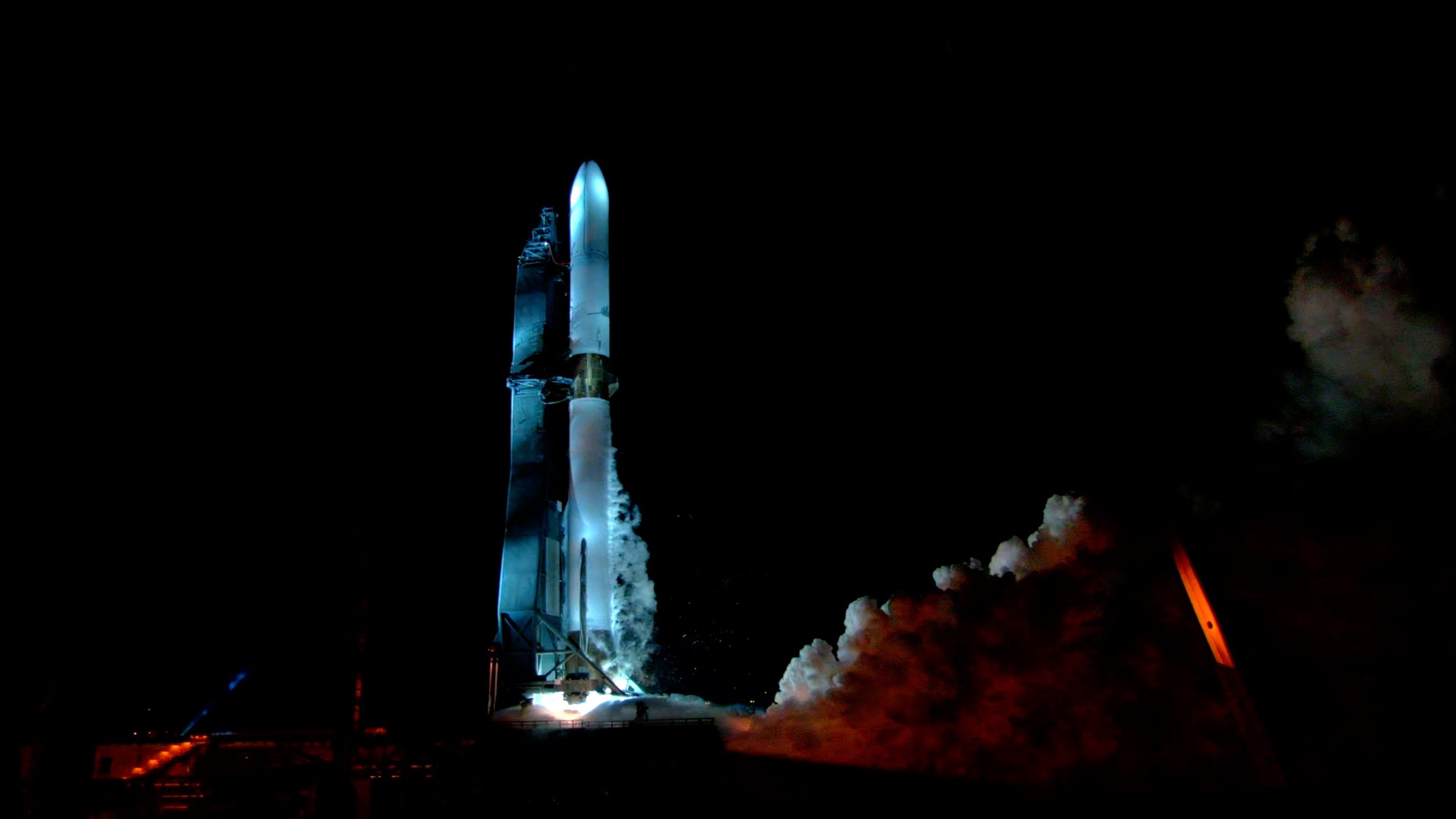
On January 16, 2025, New Glenn successfully completed its maiden flight from Launch Complex 36 at Cape Canaveral, Florida. This mission, named NG-1, had the primary objective of deploying the experimental Blue Ring Pathfinder satellite into medium Earth orbit (MEO). The launch proceeded smoothly, marking a major milestone for Blue Origin in orbital spaceflight. However, the booster recovery attempt failed. Blue Origin has not yet disclosed the cause of this failure
“I’m incredibly proud New Glenn achieved orbit on its first attempt,” said Dave Limp, CEO, Blue Origin. “We knew landing our booster, So You’re Telling Me There’s a Chance, on the first try was an ambitious goal. We’ll learn a lot from today and try again at our next launch this spring. Thank you to all of Team Blue for this incredible milestone.”
With the success of this maiden flight, Blue Origin plans to use New Glenn for various missions, including commercial satellite deployments, scientific missions, and potentially crewed flights. The reusability of the first stage aims to reduce costs and increase launch frequency, further strengthening Blue Origin’s position in the heavy-lift launch market.
To watch the inaugural flight of New Glenn, you can view the following video:
Source
The press release published by Blue Origin following the maiden flight is available here. This article is a translation from Agences-Spatiales