

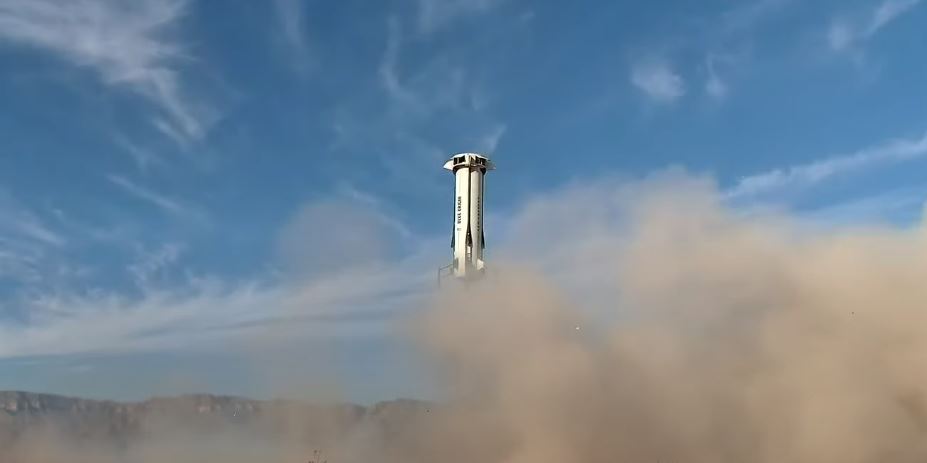
Mission NS-29: New Shepard Simulates Lunar Gravity
Blue Origin‘s latest New Shepard flight (Mission NS-29) took place on February 4. For the first time, New Shepard simulated lunar gravity and carried 30 payloads, all but one dedicated to testing technologies related to lunar exploration. Seventeen of the mission’s payloads are supported by NASA‘s Flight Opportunities program.
New Shepard Simulates Lunar Gravity
The New Shepard crew capsule used its Reaction Control System (RCS) to achieve approximately 11 rotations per minute. This rotation rate simulated a gravity equivalent to one-sixth of Earth’s at the midpoint of the capsule’s compartments. With this lunar gravity simulation, customers can accelerate the development and validation of their technologies for lunar payloads at a significantly lower cost. Until now, lunar gravity could only be simulated for a few seconds at a time, either by centrifuge, drop towers, or for about 20 seconds aboard parabolic flights.
Key Moments of Mission NS-29
The mission successfully demonstrated the capability to simulate lunar gravity, providing valuable data for future lunar exploration technologies. The payloads experienced roughly two minutes of lunar gravity forces during the flight. This advancement offers a new method for testing lunar technologies, enabling researchers to conduct experiments in a relevant environment without leaving Earth’s vicinity.
For a visual overview of the mission, you can watch the launch here:
La NASA is pleased to conduct tests simulating lunar gravity at a lower cost.
“Commercial companies are critical to helping NASA prepare for missions to the Moon and beyond,” said Danielle McCulloch, program executive of the agency’s Flight Opportunities program. “The more similar a test environment is to a mission’s operating environment, the better. So, we provided substantial support to this flight test to expand the available vehicle capabilities, helping ensure technologies are ready for lunar exploration.”
Source
The press release of the launch published by Blue Origin on 02/04/2025 is here. To learn more about the experiments conducted by NASA, click here. Original article published on Agences-Spatiales.