





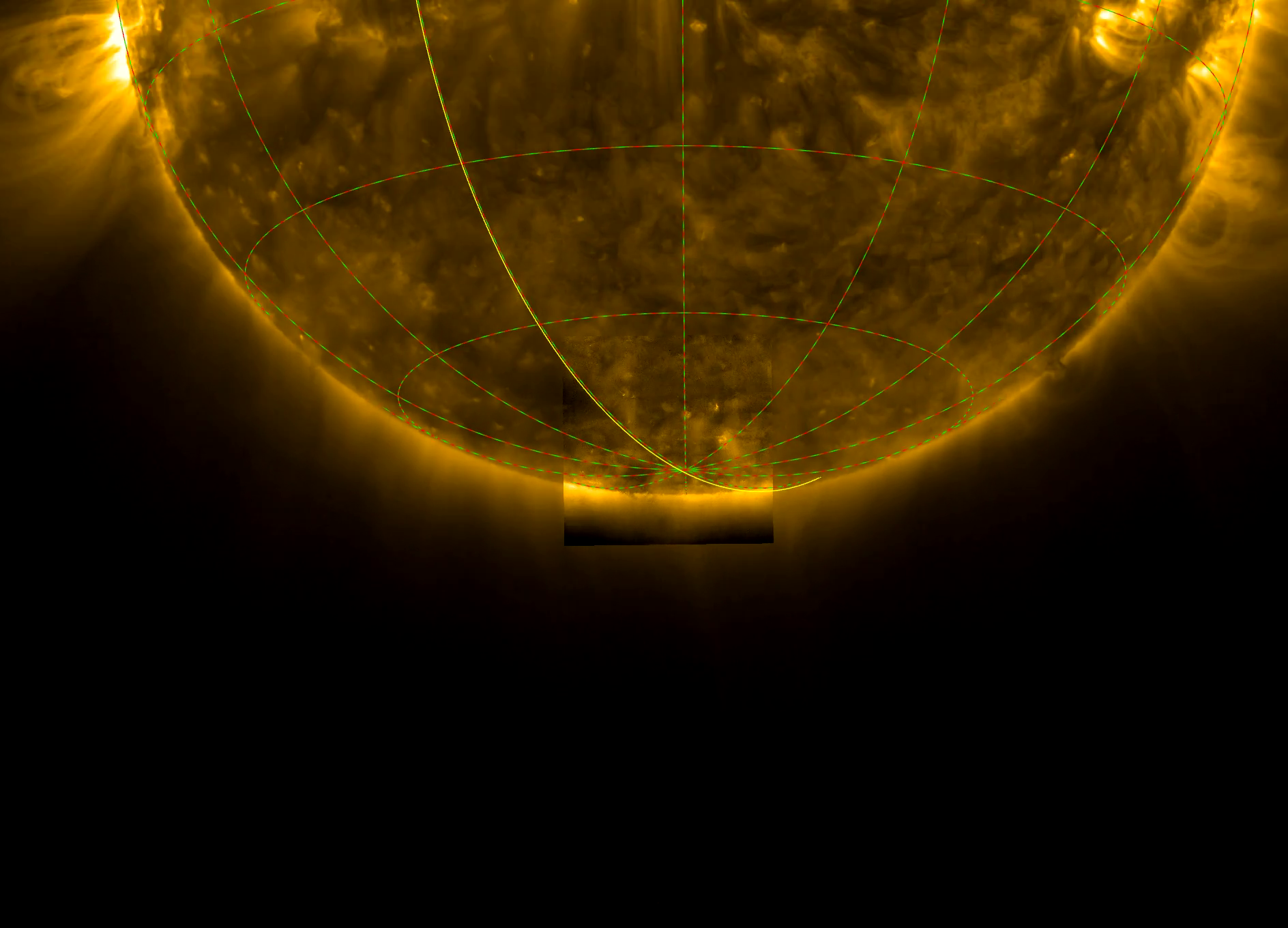
Historic First Images of the Sun’s South Pole (Solar Orbiter)
In March 2025, a major scientific milestone was achieved in solar exploration: for the very first time, the Solar Orbiter probe—developed by the European Space Agency (ESA) in collaboration with NASA—captured unprecedented direct images of the Sun’s south pole. This breakthrough marks a turning point in our understanding of our star, particularly regarding the complex dynamics of its magnetic field and the resulting phenomena such as solar eruptions and the solar wind.
A Unique Perspective: Discovering the Sun’s South Pole
Solar Orbiter accomplished the technical feat of tilting 17 degrees below the solar equator plane, enabling it to directly photograph the Sun’s south pole—an area previously out of reach. This unique vantage point opens a new window for studying solar phenomena that directly affect our space environment.
Key Discoveries
The Chaotic Magnetic Field at the South Pole
The PHI instrument (Polarimetric and Helioseismic Imager) revealed a surprisingly chaotic magnetic landscape at the Sun’s south pole. The images show an unusual mix of small-scale positive and negative magnetic fields. This phenomenon is linked to the approach of solar maximum—a period during which the Sun’s global magnetic field is about to reverse. Understanding these variations is crucial for predicting solar activity cycles and their impacts on Earth.

Solar Jets and Solar Wind Observed at High Latitude
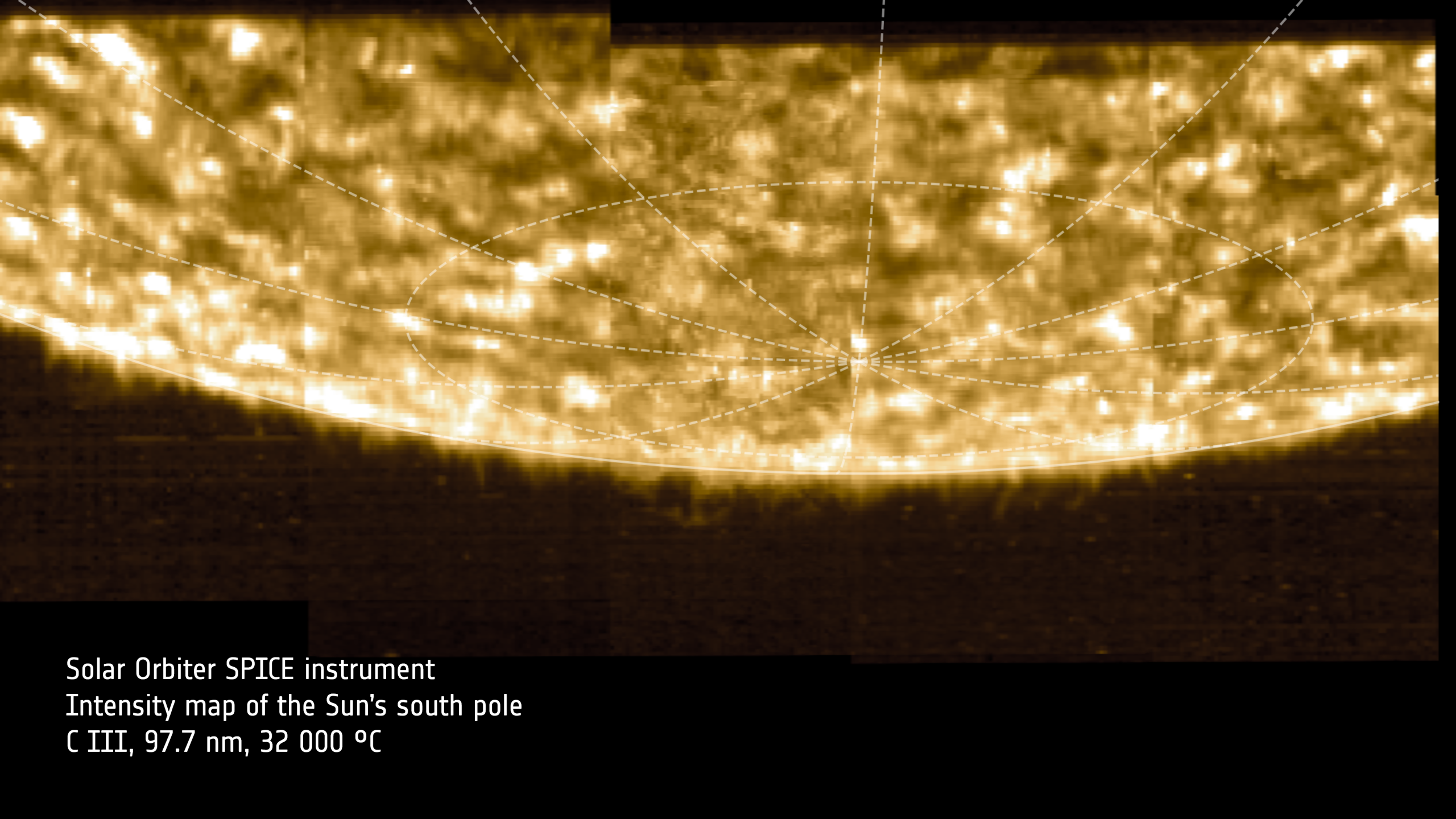
Using the SPICE instrument (Spectral Imaging of the Coronal Environment), Solar Orbiter has, for the first time, performed Doppler measurements at high solar latitudes. This allowed scientists to precisely observe the rapid movements of particles at the boundary between the Sun’s surface and its corona. These groundbreaking observations revealed highly dynamic jets of solar particles, which are likely contributing to the solar wind. Such data will greatly enhance our ability to forecast solar storms—vital for safeguarding Earth’s technological infrastructure.

Unknown Structures in the Solar Corona
The EUI instrument (Extreme Ultraviolet Imager) captured previously unseen structures, such as arches and plumes of hot plasma emerging from the Sun’s south pole. These features play a crucial role in understanding the extreme temperatures of the solar corona, which can reach several million degrees Celsius—a long-standing mystery that has intrigued scientists for decades.
Why Do These Discoveries Matter?
These new observations provide critical insights into how the Sun functions and the potential impacts of its fluctuations on our planet. By better understanding the behavior of the Sun’s magnetic field, scientists aim to predict solar storms more accurately—events that can severely disrupt satellites, radio communications, and even power grids on Earth. From a scientific standpoint, these findings refine theoretical models of the solar cycle and enhance our broader understanding of stellar physics, which is fundamental to modern astrophysics.

The Solar Orbiter’s next solar exploration
Solar Orbiter doesn’t stop there. The next crucial milestone will be in late 2026, when the probe will increase its orbital inclination to 24 degrees following a flyby of Venus, then to 33 degrees in 2029. These future orbital positions will provide even more comprehensive and precise views of the Sun’s polar regions, enabling an even deeper and more promising exploration of its mysteries.
The Historic Capture of the Sun’s South Pole by Solar Orbiter
Solar Orbiter’s historic imaging of the Sun’s south pole marks a major scientific breakthrough in solar research. These unprecedented observations enhance our ability to anticipate potentially hazardous solar phenomena and open exciting new avenues in our quest to understand our star—the true engine of life on Earth. Solar exploration thus remains vital not only for fundamental science but also for protecting the technological safety of our planet.
Source
Read the article published by ESA on 11/06/2025 [here].