


Perseverance Detects Lightning on Mars for the First Time
For decades, scientists have suspected that the Martian atmosphere could generate electrical phenomena, despite being extremely thin and lacking Earth-like thunderstorms. This long-standing hypothesis has now been confirmed: NASA’s Perseverance rover has detected Lightning on Mars for the first time, within dust devils and dust storms sweeping across the planet. This discovery represents a major breakthrough in our understanding of Martian weather and atmospheric processes.
A first direct detection of electricity on Mars
Mars has an atmosphere about one hundred times thinner than Earth’s, composed mostly of carbon dioxide. Unlike our planet, it does not experience rain-driven storms or towering thunderclouds capable of producing large, visible lightning bolts. However, Mars is notorious for its intense dust activity, including dust devils and planet-wide dust storms that can last for weeks.
For many years, scientists predicted that these dust phenomena could generate electrical charges through friction between dust grains. Until now, however, there had been no direct, in situ confirmation. Perseverance has finally provided that missing evidence by detecting tiny electrical discharges occurring in the Martian atmosphere.
The crucial role of Perseverance’s microphone
This discovery was made possible thanks to the microphone aboard Perseverance’s SuperCam instrument, a Franco-American system primarily designed to study Martian rocks using laser spectroscopy. In addition to its geological mission, the microphone records environmental sounds on Mars, including wind gusts, dust impacts, and passing dust devils.
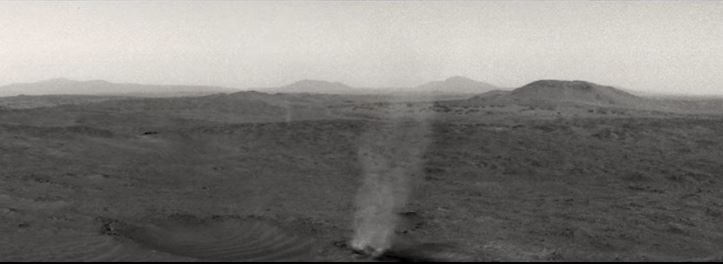
During several encounters with dust devils, scientists identified very short, distinctive acoustic signals embedded within the recordings. These sharp “crackling” sounds are consistent with small electrical sparks, similar to static discharges. The signals were detected when dust devils passed close to, or directly over, the rover, allowing unprecedented insight into the electrical behavior of Martian dust storms.
Miniature lightning inside dust devils
Unlike terrestrial lightning, these Martian events are not massive flashes crossing the sky. Instead, they are micro-discharges, produced by a process known as the triboelectric effect. As countless dust grains collide and rub against each other inside dust devils or storms, they exchange electric charges. Over time, this charge separation builds up until it is suddenly released as a small electrical spark.
By analyzing dozens of hours of audio recordings, researchers identified more than fifty distinct electrical events. Some were clearly linked to well-defined dust devils, while others were associated with larger dust storm fronts moving across the Martian surface.
Why this discovery matters
The confirmation of lightning-like electrical activity on Mars has significant scientific implications. First, it validates theoretical models developed over several decades that predicted the existence of atmospheric electricity driven by dust rather than water. Second, these electrical discharges may influence Martian atmospheric chemistry, potentially producing reactive compounds capable of altering surface materials or degrading organic molecules.
This finding is also important for future robotic and human missions. Although these micro-sparks are far less energetic than Earth’s lightning, they could still affect sensitive instruments or contribute to electrostatic wear on equipment. Understanding these processes is essential for designing more robust technologies for long-term exploration of Mars.
A new perspective on Martian weather
These observations reveal that Mars’ weather system is more dynamic and complex than previously thought. On the Red Planet, it is not water and clouds that drive electrical activity, but dust and wind. By uncovering the presence of electrical discharges in dust devils, Perseverance has opened a new window into the physical processes shaping Mars’ environment.
Further studies of these phenomena may help scientists better understand the planet’s climate evolution, surface chemistry, and the challenges future explorers will face on Mars.