
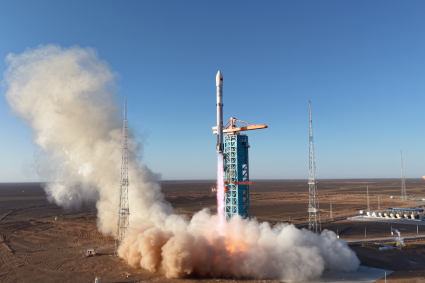





HERA Mission Overview
In September 2022, NASA’s DART (Double Asteroid Redirection Test) mission made history by colliding with the asteroid Dimorphos, the natural satellite of Didymos. The goal was to test the feasibility of altering an asteroid’s orbit through a kinetic impact, a technique considered for planetary defense against potential space threats. To complement this experiment, the European Space Agency (ESA) launched the Hera mission in 2024, tasked with studying the aftermath of DART’s impact in detail. This scientific and technological mission will provide crucial data on Dimorphos’ internal structure, surface characteristics, and the effectiveness of the deflection caused by the collision.
Mission Timeline
Launch and Initial Journey
The Hera mission launched on October 2, 2024, aboard a SpaceX Falcon 9 rocket from Cape Canaveral, Florida. After reaching orbit, the probe began its journey toward the Didymos-Dimorphos asteroid system, located approximately 11 million kilometers from Earth.
Liftoff of @ESA’s Hera! pic.twitter.com/mMoNPzX0b6
— SpaceX (@SpaceX) October 7, 2024
Martian Gravity Assist
In March 2025, Hera performed a gravity assist maneuver by flying past Mars. This flyby helped adjust its trajectory while also providing an opportunity to observe Deimos, one of Mars’ moons.

Approaching Didymos and Studying Dimorphos
After nearly two years of travel, Hera will reach the Didymos system in 2026. The spacecraft will enter orbit around Dimorphos and begin its detailed study. Over six months, Hera will analyze the asteroid’s surface, internal structure, and surrounding environment.
Two onboard CubeSats, Milani and Juventas, will be deployed for close-up investigations:
- Milani will study Dimorphos’ surface composition.
- Juventas will use a penetrating radar to probe the asteroid’s interior.
The data collected will help assess the effectiveness of DART’s impact and refine planetary defense strategies. Additionally, it will provide new insights into the formation and evolution of binary asteroids, which remain poorly studied objects in the Solar System.
Mission Objectives
The Hera mission aims to achieve several key objectives, both scientific and strategic.
Studying the Effects of the DART Impact
One of Hera’s primary objectives is to assess the effectiveness of the asteroid deflection technique tested by NASA’s DART mission. By precisely measuring Dimorphos’ orbital change and analyzing the extent of the damage caused by the impact, scientists will gain a deeper understanding of how a celestial body reacts to a high-energy collision.
Analyzing Dimorphos’ Structure and Composition
Hera will thoroughly examine the surface, density, and internal structure of Dimorphos using its onboard cameras and penetrating radar. These analyses will help determine whether the asteroid is a solid body or a loosely compacted rubble pile—a critical factor for planning future planetary defense missions.
Testing New Autonomous Navigation Technologies
Hera will also serve as a testbed for autonomous navigation systems powered by artificial intelligence. These technologies could be adapted for future asteroid exploration missions, as well as missions to moons or other celestial objects in the Solar System.
Contributing to the Understanding of Binary Asteroids
Binary asteroids like Didymos and Dimorphos remain poorly understood. Studying their origin, evolution, and gravitational interaction could provide valuable insights into the formation of small celestial bodies in the Solar System.
Source
The HERA mission page on the ESA website can be found here.