Mars by Hubble: New images of Mars were taken between December 28 and 30, 2024, by the Hubble Space Telescope.
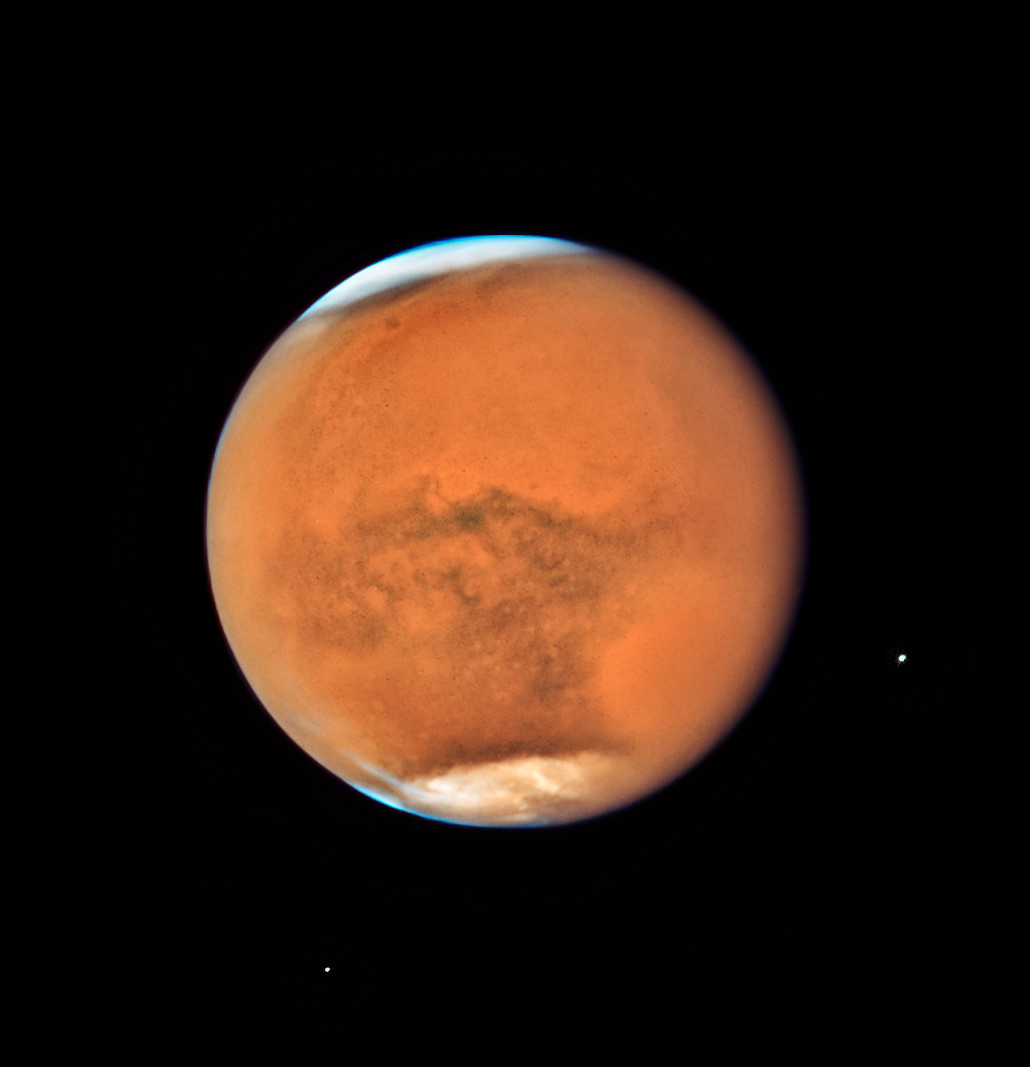
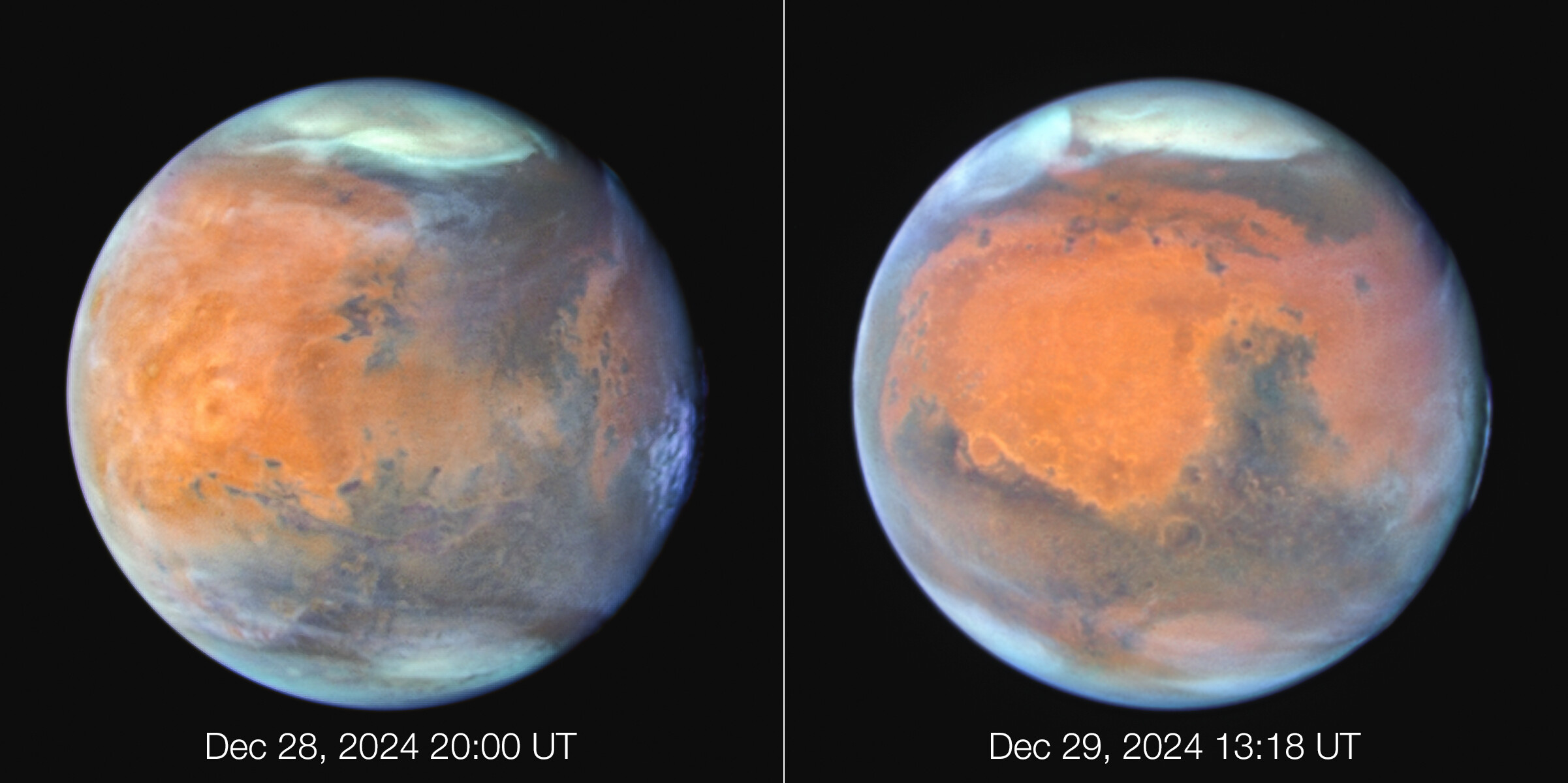
This is a combination of Hubble Space Telescope images of Mars taken from December 28th to 30th, 2024. At the midpoint of the observations, Mars was approximately 98 million kilometres from Earth. Thin water-ice clouds that are apparent in ultraviolet light give the Red Planet a frosty appearance. The icy northern polar cap was experiencing the start of Martian spring. Credit: NASA, ESA, STScI
In the left image, the Tharsis Plateau is visible with its chain of dormant volcanoes. The large volcano, Olympus Mons, protrudes from the clouds at the 10 o’clock position near the northwest rim. At 21,000 meters (70,000 feet), it is 2.5 times higher than Mount Everest above sea level. Valles Marineris, the 4,000-kilometer-long canyon, appears as a dark linear feature near the center left. In the right image, high-altitude clouds visible in the evening skirt the planet’s eastern limb. The 2,250-kilometer-wide Hellas impact basin, the remnant of an ancient asteroid, is visible far to the south. Most of the hemisphere is dominated by the famous shark-fin-shaped feature, Syrtis Major.
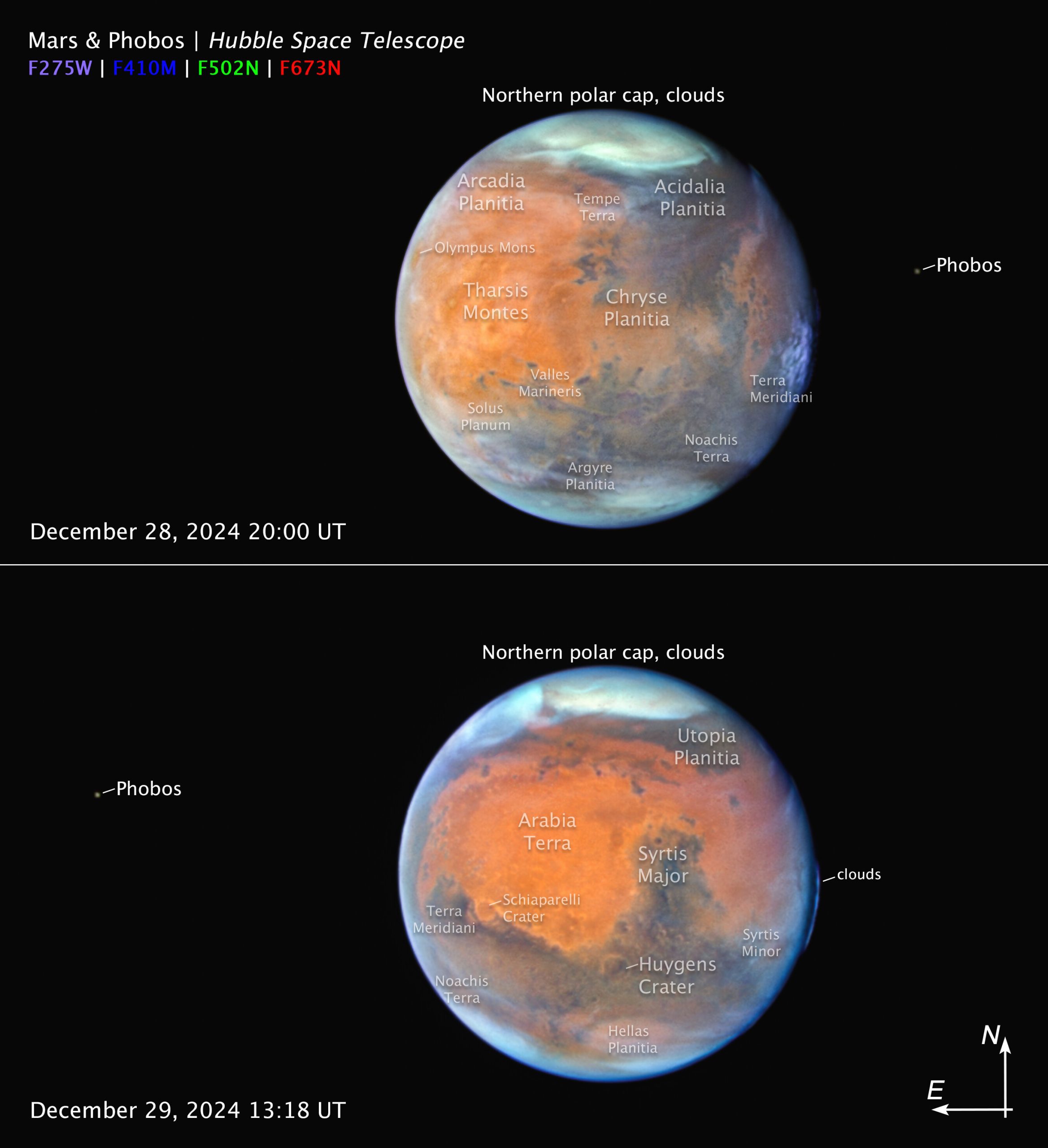
This pair of NASA/ESA Hubble Space Telescope images of Mars taken on 28 December (top) and 29 December (bottom) 2024. Each image shows a different side of the planet, with the accompanying moon Phobos. Various features are identified in the images, including the polar ice caps and clouds, as well as multiple terrestrial features. At the midpoint of the observations, Mars was approximately 98 million kilometres from Earth. Thin water-ice clouds that are apparent in ultraviolet light give the Red Planet a frosty appearance. The icy northern polar cap was experiencing the start of Martian spring. In the top image, the bright orange Tharsis plateau is visible with its chain of dormant volcanoes. The largest volcano, Olympus Mons, pokes above the clouds at the 10 o’clock position near the northwest limb. At an elevation of over 21 000 meters, it is 2.5 times the height of Mt. Everest above sea level. Valles Marineris, Mars’ over 4,000-kilometre-long canyon system, is a dark, linear, horizontal feature near center left. In the bottom image, high-altitude evening clouds can be seen along the planet’s eastern limb. The 2,250-kilometre-wide Hellas basin, an ancient asteroid impact feature, appears far to the south. Most of the hemisphere is dominated by the classical “shark fin” feature, Syrtis Major.
At the time of the observations, Mars was approximately 98 million kilometers from Earth. Thin clouds of water ice, visible under ultraviolet light, give the Red Planet a frosty appearance. The ice-covered northern polar cap was experiencing the beginning of Martian spring.
Source
Find the articles published on the Hubble telescope website on 04/23/2025 here and here