






2017 OF201: A Distant Dwarf Planet and a Missing Link to Planet 9?
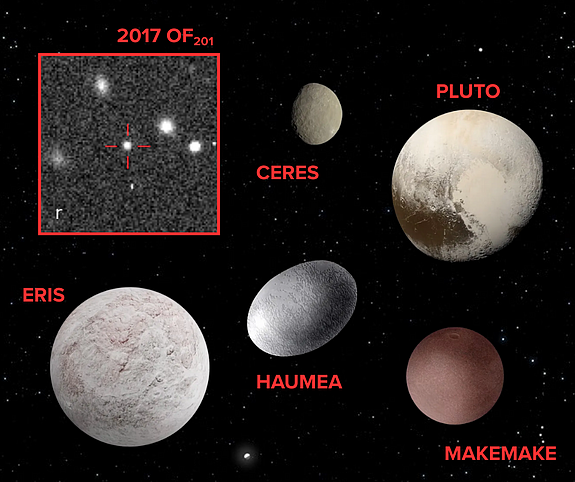
Discovered through archival observations between 2011 and 2018, 2017 OF₍₂₀₁₎ is an extreme trans-Neptunian object whose unusual orbit is puzzling astronomers. With an estimated diameter of about 700 kilometers, it may qualify as a dwarf planet. Its orbit, which carries it more than 1,600 astronomical units (AU) from the Sun, makes it one of the most distant objects ever identified. This remarkable trajectory is reigniting discussions about the dynamics of the outer Solar System and raising the question of a hidden population — or even the existence of a still-hypothetical ninth planet.
Discovery and Identification
The discovery of 2017 OF₍₂₀₁₎ was not the result of a targeted observation campaign, but of a meticulous search through astronomical archives. A team led by Sihao Cheng, with Jiaxuan Li and Eritas Yang (Princeton University), identified the object by cross-referencing images taken between 2011 and 2018 by the Blanco Telescope (Chile) and the Canada-France-Hawaii Telescope (Hawai‘i). The object appears in 19 images spread over seven years, allowing for a reliable orbital determination despite its extreme distance.
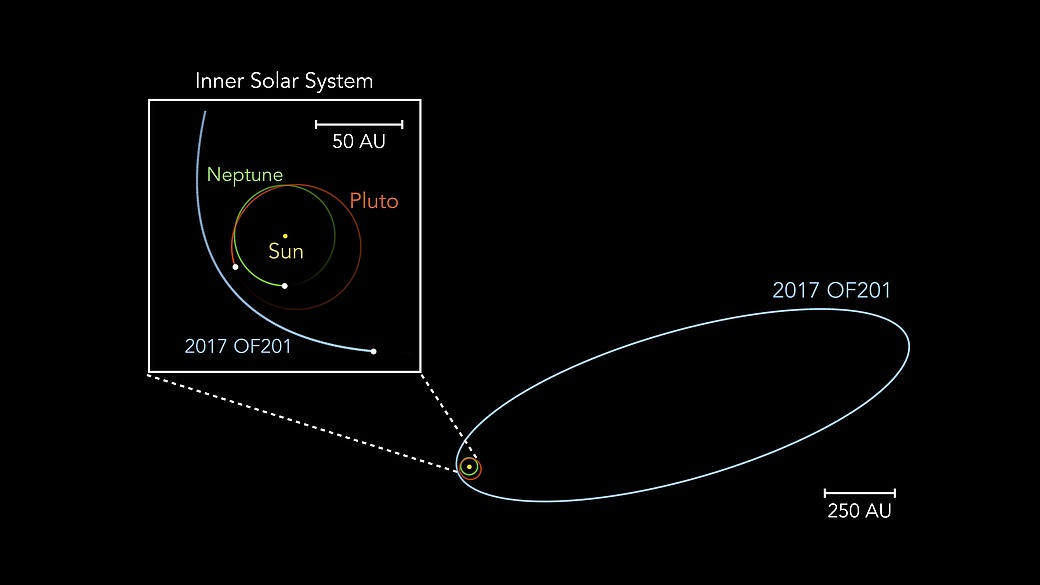
This detection method highlights the still largely untapped potential of astronomical databases. It also reveals an observational bias: 2017 OF201 was detected only because it was temporarily near its perihelion, at “just” 44.5 AU from the Sun — a distance still within the reach of current telescopes. This suggests that a vast population of similar objects, farther away or more faintly illuminated, remains invisible — yet very real.
The object was officially announced on May 21, 2025, by the Minor Planet Center of the International Astronomical Union, further fueling interest in mapping the outermost regions of the Solar System.
Physical and Orbital Characteristics
With an estimated diameter between 550 and 850 kilometers, 2017 OF₍₂₀₁₎ falls within the typical size range for objects considered potential dwarf planets. This estimate is based on its apparent brightness and a reasonable assumption about its albedo, in the absence of more precise direct observations. Its mass and composition remain unknown, but it is presumed to be an icy body, similar to other trans-Neptunian objects.
Its orbit, however, is exceptional. It has a semi-major axis of approximately 860 astronomical units (AU), a perihelion of 44.5 AU — slightly beyond Pluto’s orbit — and an aphelion reaching nearly 1,600 AU, bringing it close to the inner boundaries of the Oort Cloud. Its orbital period is estimated to exceed 25,000 years — a timescale far beyond that of typical planetary cycles.
Such an orbit suggests a turbulent past, marked by strong gravitational interactions, likely with the giant planets of the Solar System or possibly with other massive, as yet undiscovered bodies. It also confirms that 2017 OF201 belongs to the category of extreme trans-Neptunian objects (ETNOs), the study of which provides valuable insights into the large-scale dynamical evolution of the Solar System.
Scientific Implications
The unusual orbit of 2017 OF₍₂₀₁₎ raises major questions about the dynamics of the outer Solar System. Unlike several other extreme trans-Neptunian objects (such as Sedna or Leleākūhonua), its orbital orientation does not align with the clustering that led to the formulation of the Planet 9 hypothesis — a hypothetical massive planet located several hundred astronomical units away. This “outlier” behavior suggests that multiple distinct mechanisms may be shaping and perturbing extreme orbits. Possible scenarios include past interactions with the giant planets, close stellar encounters during the Sun’s early history, or as-yet poorly understood secular resonances.
More broadly, the detection of 2017 OF201 in archival data — and within a narrow region of the sky — implies the existence of a vast population of similar objects. Some researchers estimate that there could be hundreds of comparable bodies, collectively amounting to about 1% of Earth’s mass. This unseen reservoir is a major scientific target, as it helps refine models of the primordial disk’s evolution and sheds light on the gravitational interactions taking place in the most remote regions of the Solar System.
Future Prospects
The discovery of 2017 OF₍₂₀₁₎ highlights the growing importance of archival surveys and long-term studies in exploring the far reaches of the Solar System. However, to better understand the nature of this object and its kin, new observations will be required. In particular, the accuracy of 2017 OF201’s orbital calculations depends on continued tracking. Refining its parameters will allow researchers to test its long-term stability, assess potential perturbative influences (including the possible presence of Planet 9), and improve models of the inner Oort Cloud.
This discovery does not close an investigation — it opens one. By revealing the presence of such a distant and eccentric object, 2017 OF201 invites us to reconsider the boundaries of the known — and to search, in the outer darkness, for other worlds in exile.
By briefly appearing in the field of ground-based telescopes, 2017 OF₍₂₀₁₎ has revealed the existence of a complex dynamical environment at the edges of the Solar System. Neither aligned with other ETNOs nor easily explained by classical gravitational models alone, this object both puzzles and inspires. It points to a still largely invisible reservoir of distant objects — possibly as numerous as the major planets. Its eccentric trajectory, significant size, and the circumstances of its discovery make it a true ambassador of the unexplored regions of our Solar System. It reminds us that much of the Solar System remains to be discovered — and that each distant detection adds another piece to the grand puzzle of our planetary origins.
Source
Read the article published on May 22, 2025, by IAS [here].