




Tianwen-2: China Sets Its Sights on an Asteroid and a Comet
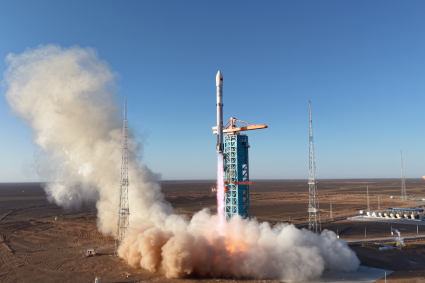
On May 28, 2025, China marked another major milestone in its ambitious space program with the launch of Tianwen-2, an interplanetary exploration mission with bold and unprecedented objectives. Designed by the China National Space Administration (CNSA), this mission aims to closely study two largely unknown celestial bodies: a near-Earth quasi-satellite named Kamoʻoalewa, and an active comet, 311P/PANSTARRS. The primary goal: collect samples from the asteroid and return them to Earth, before continuing the journey toward a more distant target for further in-depth analysis.
A Unique Dual Objective
Study and Sample Return from Asteroid Kamoʻoalewa
The first objective of Tianwen-2 focuses on (469219) Kamoʻoalewa, a small asteroid (estimated between 40 and 100 meters in diameter) discovered in 2016. This celestial body follows a heliocentric orbit while remaining close to Earth, making it a quasi-satellite.
Kamoʻoalewa holds particular interest due to its orbital stability and suspected composition, which may suggest a lunar origin. Spectroscopic analyses indicate that its surface shows similarities to lunar rock. This raises the possibility that it could be a fragment ejected from the Moon after an ancient impact — making the mission even more valuable for understanding material exchanges within the Earth-Moon system.
Tianwen-2 is expected to reach Kamoʻoalewa in July 2026, after a cruise phase of more than a year.
A Seven-Month Science Phase
A seven-month scientific characterization phase is planned: surface mapping, compositional analysis, regolith observation, and study of mechanical properties. The spacecraft will use a robotic anchoring system to stabilize its position during sampling — a major challenge due to the asteroid’s extremely low gravity. The mission team recalls the bounces of the Philae lander during the Rosetta mission.
The collected samples will be sealed in a return capsule and brought back to Earth in November 2027 — a first for China in the context of an interplanetary sample return mission.
Exploration of Comet 311P/PANSTARRS (2013 P5)
After releasing the sample capsule toward Earth, Tianwen-2 will continue on to a second target: 311P/PANSTARRS, an unusual comet also classified as an active asteroid. Discovered in 2013, this object fascinates astronomers with its hybrid behavior — following an asteroidal orbit while exhibiting intermittent cometary activity, including the emission of dust plumes.
To reach 311P, the spacecraft will perform an Earth gravity assist, a maneuver that saves fuel by altering its trajectory using Earth’s gravity. The arrival near the comet is expected later this decade, likely between 2029 and 2030, depending on available maneuver windows. Tianwen-2 will conduct detailed observations of the comet: studying its nucleus, activity, and the composition of ejected dust. These data will help scientists assess the transition between asteroids and comets, and could provide clues about the presence of water and organic compounds in such objects — contributing to our understanding of Earth’s water origins and prebiotic chemistry in the Solar System.
With this two-part mission, Tianwen-2 becomes the first spacecraft to combine an asteroid sample return with the extended exploration of an active comet — highlighting both the ambition and the growing complexity of China’s space program.
A Bold Technological Mission
The Tianwen-2 mission serves as a major demonstration of China’s current space capabilities. At the intersection of multiple disciplines — autonomous navigation, robotics, sample collection, and interplanetary return — the mission employs a complex set of innovative technical solutions designed to operate in the demanding environments of small celestial bodies.
An Innovative Sampling System
One of the mission’s most critical elements is the sample acquisition and storage system. Unlike impact-based collection techniques used in missions like Hayabusa or OSIRIS-REx, Tianwen-2 employs a robotic anchoring approach.
Two articulated robotic arms, equipped with adhesion systems and sensors, will grip the unstable surface of Kamoʻoalewa to perform a targeted sampling operation. This method is designed to maximize both the quantity and quality of collected material, while minimizing the risk of uncontrolled dust ejection into space.
High-Precision Scientific Instruments
The spacecraft carries 11 scientific instruments developed in China, including:
-
A multispectral camera for surface mapping
-
An infrared and gamma-ray spectrometer for mineralogical and elemental analysis
-
A ground-penetrating radar (GPR) to probe the asteroid’s internal structure
-
Dust and plasma sensors for the cometary phase
These instruments will provide a multi-dimensional view of the targets — from composition and texture, to surface dynamics and interaction with the space environment.
Autonomous Navigation and Interplanetary Maneuvers
The asteroid’s ultra-low gravity environment makes navigation especially challenging. Tianwen-2 must adjust its position with extreme precision to conduct scientific operations without collision.
To achieve this, the spacecraft is equipped with vision-based autonomous navigation systems, capable of recognizing and tracking surface landmarks in real time. The mission’s continuation toward 311P/PANSTARRS will also require careful chemical propulsion management, assisted by a series of gravity-assisted trajectory corrections.
This phase demonstrates China’s growing capability to manage multi-year deep-space missions.
Planned Sample Return
The final phase of Tianwen-2 — the controlled return of asteroid samples to Earth — is one of the mission’s greatest challenges. A hardened reentry capsule, designed to withstand the extreme conditions of Earth reentry, will be released near our planet. The operation will demand exceptional orbital precision to ensure the safe recovery of these valuable extraterrestrial geological samples.
A New Milestone for Chinese Space Technology
By combining cutting-edge technology, advanced robotics, and interplanetary navigation, Tianwen-2 represents a turning point in China’s mastery of high-end space technologies — paving the way for a series of future ambitious missions.
Major Scientific Goals
The Tianwen-2 mission carries strategic importance for scientific research, particularly in the fields of comparative planetology and the origin of the Solar System. By targeting two very different objects — a near-Earth quasi-satellite asteroid and an active comet — the mission addresses fundamental questions that go far beyond simple exploration.
Understanding the Formation and Evolution of the Solar System
Asteroids and comets are considered primitive remnants of the early Solar System. Largely unchanged since their formation 4.6 billion years ago, they preserve materials that have not undergone the planetary differentiation processes. In this sense, the study of Kamoʻoalewa and 311P/PANSTARRS could provide crucial insights into the physical and chemical conditions of the primordial solar nebula.
The samples returned from Kamoʻoalewa will enable extremely precise isotopic and mineralogical analyses in the laboratory. These data will help reconstruct the object’s history and may even confirm a lunar origin — a hypothesis that, if validated, would have major implications for understanding ejection mechanisms and gravitational capture within the Earth-Moon system.
The Origins of Water and Organic Molecules
Comet 311P/PANSTARRS represents a rare case of a transitional object between asteroid and comet. Its sporadic activity reveals the presence of volatile materials. By observing its surface, dust jets, and the interactions between solar radiation and the released materials, Tianwen-2 will help assess the potential role of such small bodies in delivering water and organic molecules to early Earth.
This question lies at the heart of astrobiology: how were the conditions for life’s emergence established on our planet? Active comets and asteroids are often considered vectors of prebiotic material, enriching Earth with carbon, nitrogen, and volatile compounds.
Assessing Risks from Near-Earth Objects
In addition to their scientific interest, objects like Kamoʻoalewa are potentially hazardous near-Earth objects (NEOs). Their proximity to Earth makes it essential to develop a detailed understanding of their physical and dynamical properties, in order to accurately model their future orbits and anticipate impact risks.
Tianwen-2 will provide direct data on the internal structure, density, and material cohesion of these small bodies — key information for planetary defense.
A Mission for International Scientific Research
By providing samples accessible to the global scientific community and publishing its data, Tianwen-2 could also strengthen international scientific cooperation. The mission represents a unique opportunity to compare its findings with results from other missions such as OSIRIS-REx (NASA) and Hayabusa2 (JAXA) — enriching our overall understanding of small Solar System bodies.
A Bold Step in China’s Space Ambitions
With Tianwen-2, China is asserting its ambition to stand among the world’s leaders in space exploration. By combining the return of samples from a near-Earth quasi-satellite and the detailed study of an active comet, this mission is a world first — both in the diversity of its objectives and the complexity of the technologies involved.
Scientifically, Tianwen-2 opens new avenues for understanding the formation of the Solar System, the origin of volatile elements, and the evolution of small celestial bodies. The analysis of materials returned to Earth will help answer fundamental questions about the cosmic processes that led to the emergence of life.
Beyond the purely scientific stakes, Tianwen-2 also marks a strategic milestone. It highlights China’s growing technological autonomy in the space sector and its ability to conceive and execute high-value interplanetary missions. In this respect, it is a major geopolitical marker, underlining China’s definitive entry into the elite circle of space powers capable of designing, flying, and extending complex interplanetary missions.