



The Artemis Accords: Overview, Challenges, and Real Impact
Adopted in 2020 by NASA and its partners, the Artemis Accords aim to regulate future lunar and Martian missions in a peaceful, sustainable, and cooperative framework. But behind this voluntary legal structure also lies a new geopolitical dynamic. What do these accords truly bring, and do they protect space—or shape it to serve specific interests?
What are the Artemis Accords?
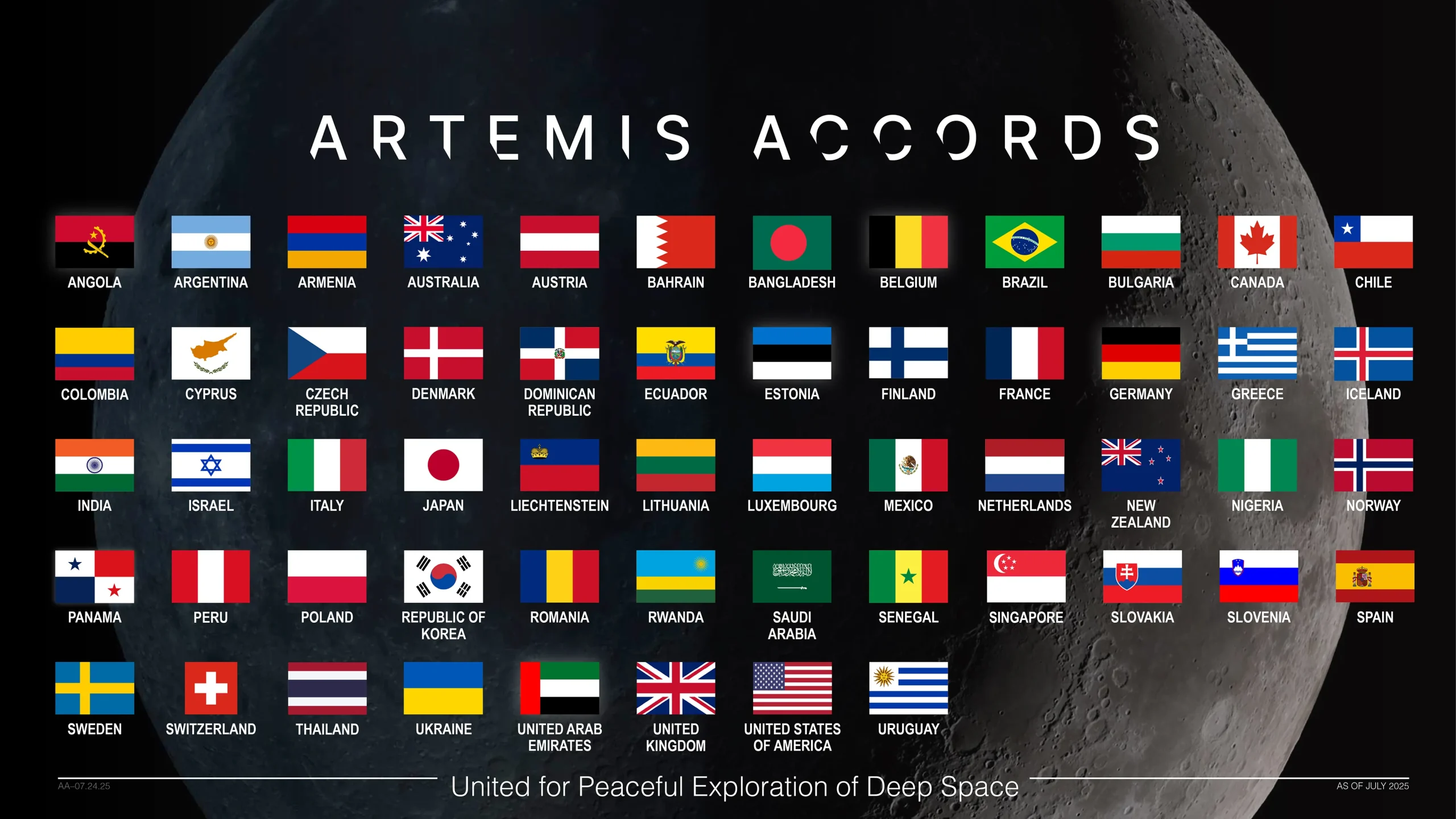
The Artemis Accords are non-binding political commitments, signed by 56 countries as of August 8, 2025. Their purpose is to formalize guidelines for responsible behavior in lunar and Martian exploration, while ensuring transparency, international cooperation, and safety in space. They complement the principles of the 1967 Outer Space Treaty, adding practical updates suited to today’s challenges.
The 12 Core Principles of the Accords
- Peaceful use of space
- Transparency of space activities
- Interoperability of space infrastructures
- Assistance to astronauts in distress
- Registration of space objects
- Sharing of scientific data
- Protection of space heritage (e.g., Apollo 11)
- Use of space resources without national appropriation
- Prevention of harmful interference between missions
- Temporary safety zones around activity sites
- Reduction of space debris
- Regular review of principles by signatories
Comparison with the Outer Space Treaty
| Theme | Outer Space Treaty (1967) | Artemis Accords (2020) |
|---|---|---|
| Legal nature | Binding treaty adopted at the UN | Non-binding political commitment |
| Scope | All space activities | Moon, Mars, comets, asteroids |
| Resource exploitation | Not explicitly allowed | Permitted under regulation, not treated as appropriation |
| Safety zones | Not provided | Establishment of temporary “safety zones” |
| Heritage protection | Not mentioned | Explicitly included |
| Membership | Over 110 states | About 50 states (2025), excluding China and Russia |
List of Artemis Accords Signatories (as of August 2025)
🌎 Americas
- North America: United States, Canada, Mexico
- Central America & Caribbean: Panama, Dominican Republic
- South America: Argentina, Brazil, Chile, Colombia, Ecuador, Peru, Uruguay
🌍 Europe
Germany, Austria, Belgium, Bulgaria, Cyprus, Denmark, Spain, Estonia, Finland, France, Greece, Iceland, Italy, Liechtenstein, Lithuania, Luxembourg, Netherlands, Poland, Czech Republic, Romania, Slovakia, Slovenia, Sweden, Switzerland, United Kingdom, Norway
🌏 Asia
Saudi Arabia, Armenia, Bahrain, Bangladesh, South Korea, India, Israel, Japan, Singapore, Thailand
🌐 Oceania
Australia, New Zealand
🌍 Africa
Angola, Nigeria, Rwanda, Senegal
A Fragmented Governance
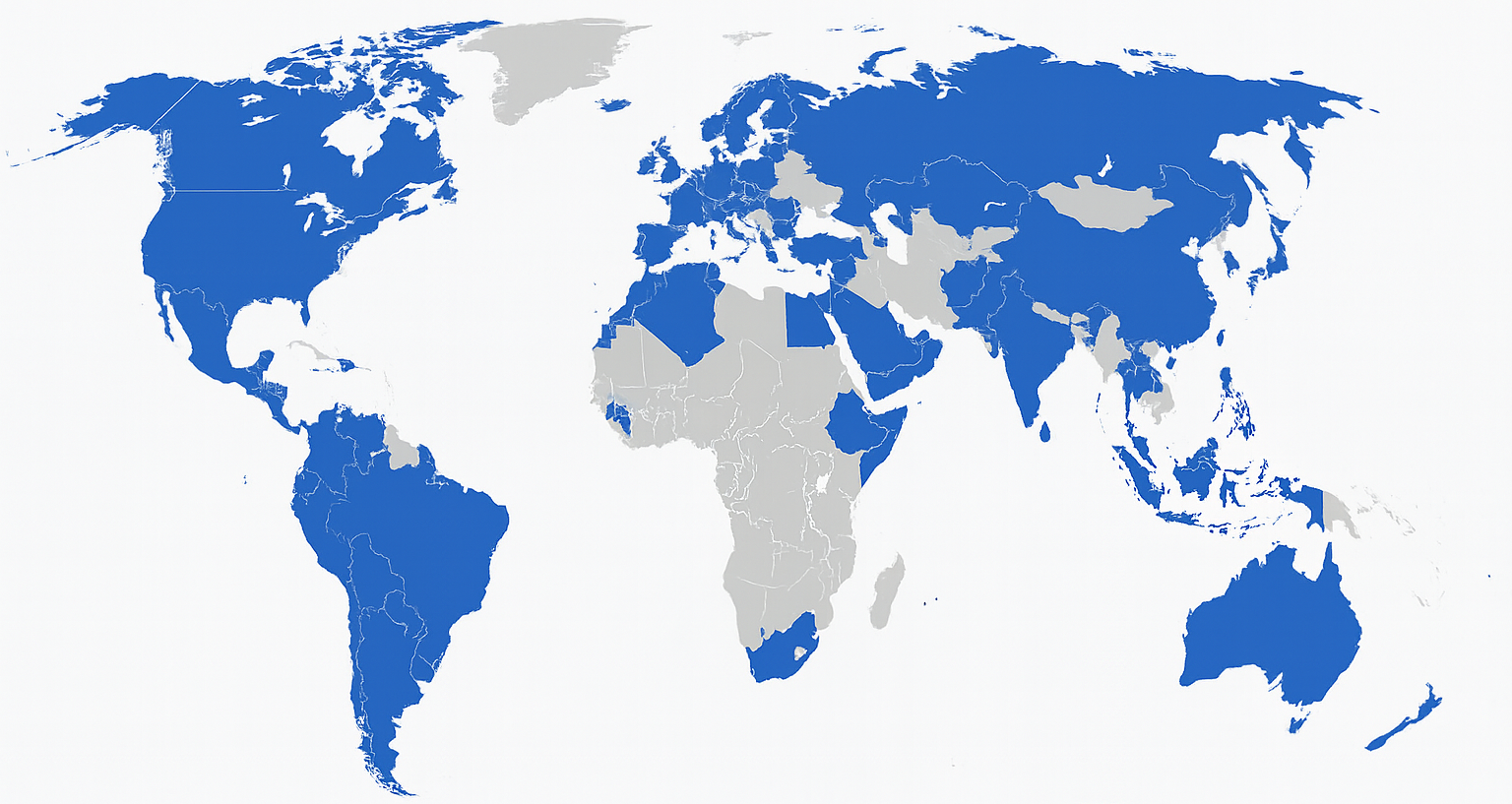
The Artemis Accords are largely supported by U.S. allies (Europe, Japan, Canada, India, etc.) but rejected by China and Russia, who are working on their own lunar base project: the International Lunar Research Station (ILRS). This division raises the question of space governance: will it evolve into a global framework, or rival geopolitical blocs?
Why Some Countries Refuse to Sign
- Distrust of a U.S.-led initiative: China and Russia criticize the text for being drafted outside the UN multilateral framework, seeing it as primarily serving U.S. interests.
- Indirect resource appropriation: “Safety zones” could advantage early arrivals, conflicting with the principle of non-appropriation.
- Competing projects: China and Russia are developing their own International Lunar Research Station (ILRS), targeted for the 2030s.
- Leadership stakes: Signing the Accords is perceived as a political alignment with Washington in an era of heightened space rivalry.
The Artemis Accords represent a pragmatic step toward structuring the next phase of space exploration. While they strengthen security and cooperation among signatories, they remain legally fragile and geopolitically limited. The future of space law will depend on whether these principles can transcend spheres of influence and rally global actors around a truly universal and equitable framework.
Source
NASA’s official Artemis Accords page is available here, the official PDF of the agreements here, and the updated list of signatories here.