





James Webb Telescope Discovers a Tiny Moon Around Uranus
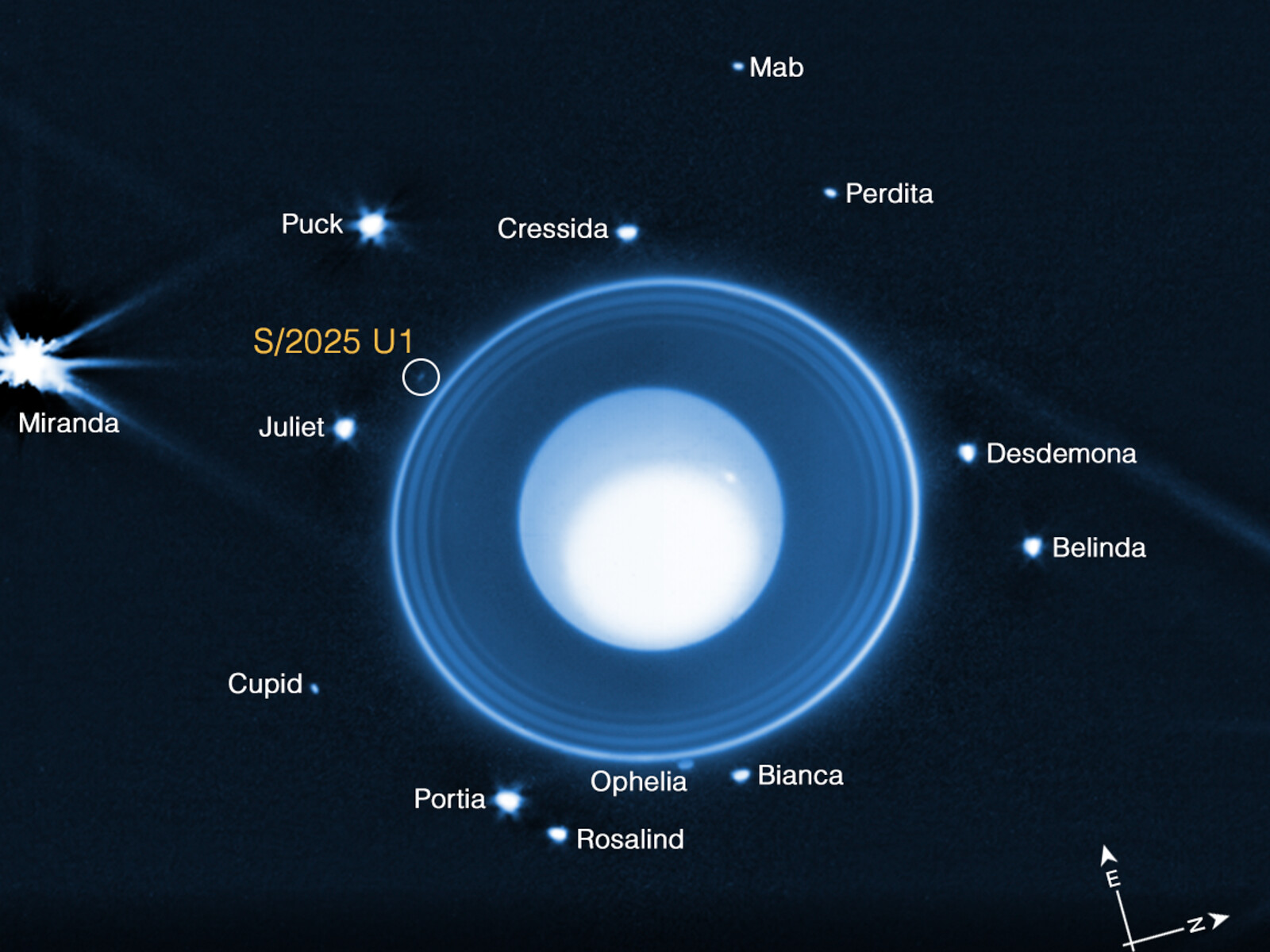
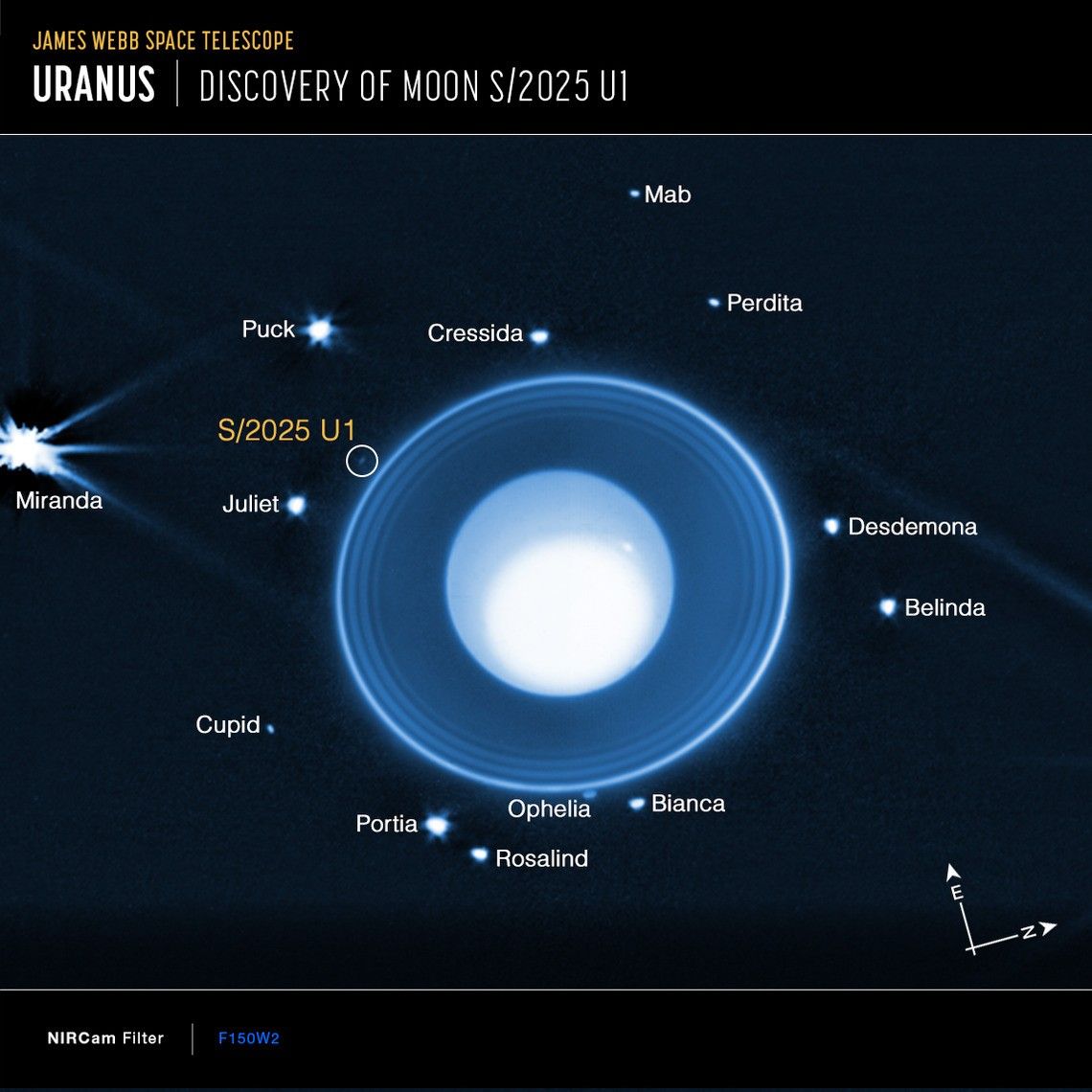
A Tiny Moon Around Uranus : On August 19, 2025, NASA announced that a new moon has been detected orbiting Uranus, bringing the total number of known satellites of this distant planet to 29. Observed thanks to the power of the James Webb Space Telescope, this small moon, provisionally designated S/2025 U1, had previously escaped all instruments, including Voyager 2 and the Hubble Telescope.
A Detection Made Possible by Webb’s Precision
The moon S/2025 U1 was identified in a series of ten images taken on February 2, 2025, using Webb’s Near-Infrared Camera (NIRCam). Each long-exposure image, lasting about 40 minutes, gathered enough light to reveal this extremely faint object. Astronomer Mark Showalter of the SETI Institute and his team led the detection. While Hubble and Voyager 2 never spotted this tiny satellite, Webb’s infrared sensitivity allowed its discovery despite an apparent magnitude close to 25.5, making it one of the faintest moons ever observed in our solar system.
Physical and Orbital Characteristics of S/2025 U1
Preliminary analyses estimate that S/2025 U1 measures about 10 kilometers in diameter—smaller than most large cities on Earth. It orbits Uranus at a distance of 56,250 kilometers from the planet’s center, between the orbits of the moons Ophelia and Bianca.
Its orbital period is very short, about 0.402 days (9.65 hours). It moves within the planet’s equatorial plane on a nearly circular orbit, suggesting that it formed in place rather than being captured later.
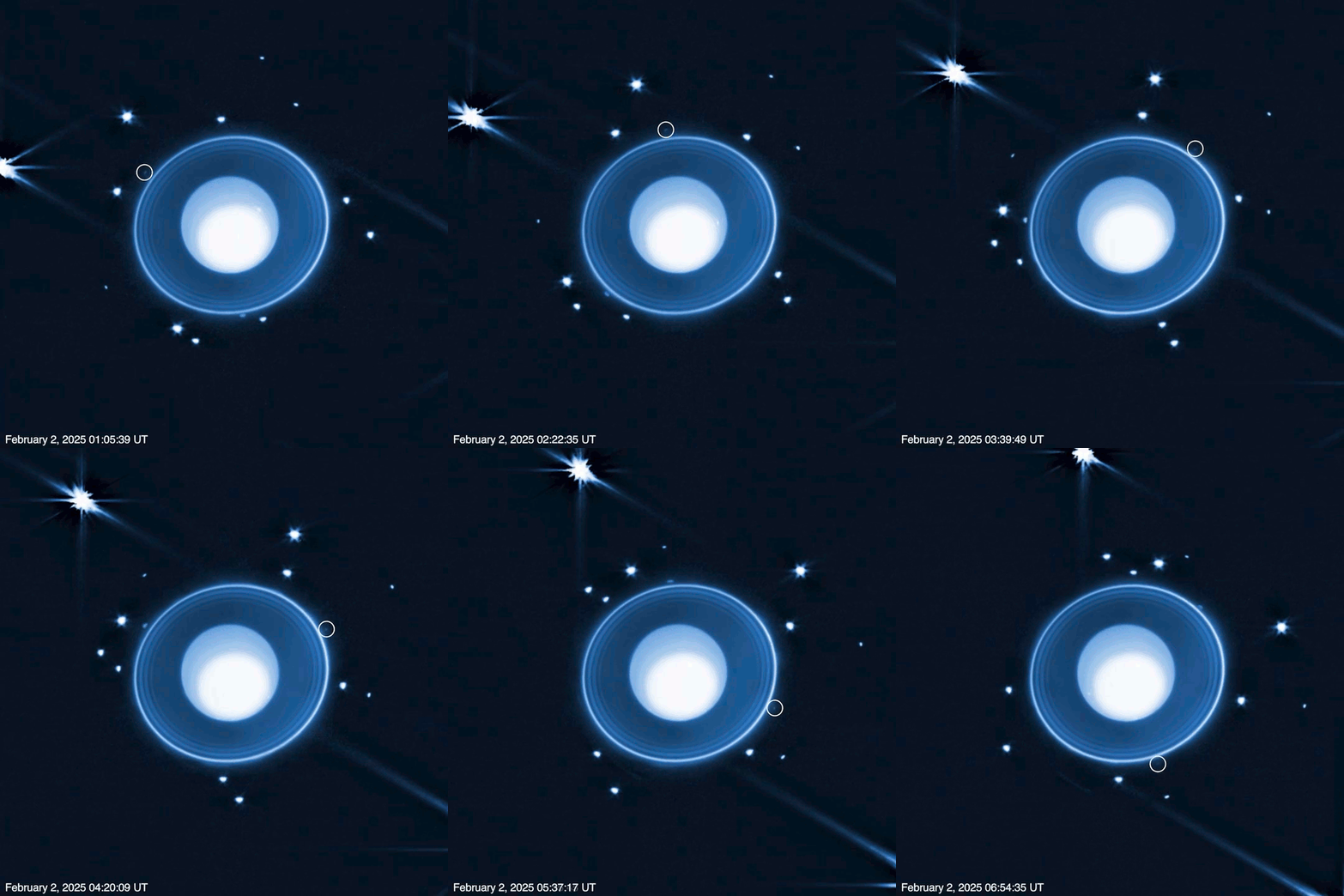
This time-lapse animation shows the new Uranian moon, designated S/2025 U1, along with 13 of the 28 other known moons orbiting the planet. Observations were made with Webb’s NIRCam over a span of about six hours on February 2, 2025.
Why Is This Discovery Important?
Beyond expanding Uranus’s lunar family, this detection highlights the James Webb Telescope’s power in observing faint, distant objects. According to team member Matthew Tiscareno, this moon is likely “the first of many,” as other satellites of similar size may still be hiding in Webb’s images.
This moon is also noteworthy for belonging to Uranus’s inner satellite group, few of which are well characterized. About 14 moons orbit near the planet’s rings, but their dynamics remain poorly understood. Studying these small bodies may offer new insights into satellite formation and the evolution of giant planetary systems.
Historical Context and Naming Tradition
The discovery of S/2025 U1 comes nearly 40 years after Voyager 2’s historic 1986 flyby, which revealed 10 new Uranian moons. However, none of Voyager’s images showed this satellite, likely due to its faintness.
By tradition, Uranus’s moons are named after characters from the works of Shakespeare and Alexander Pope. The permanent name of S/2025 U1 will be assigned by the International Astronomical Union (IAU) in the coming months.
Outlook: A New Era for Uranus Studies
This discovery opens a new chapter in exploring the Uranian system. Thanks to Webb, scientists can hope to detect additional hidden moons, as well as study the structure of Uranus’s rings, gravitational interactions, and the composition of its small satellites in unprecedented detail.
The proposed Uranus Orbiter and Probe mission, identified as a scientific priority for NASA in the 2030s, could build on these results to refine its objectives and specifically target some of these newly detected bodies.
The moon S/2025 U1 perfectly embodies the promise of the James Webb Space Telescope: to push the boundaries of what can be observed and reveal hidden structures at the edge of our solar system. Though modest in size, its discovery highlights the still-unexplored richness of Uranus and its dynamic environment. A new era of exploration is dawning for this long-overlooked ice giant, now moving to the forefront of ambitious scientific goals.
Source
See NASA’s article published on August 19, 2025 [here], and another by the SETI Institute [here].