



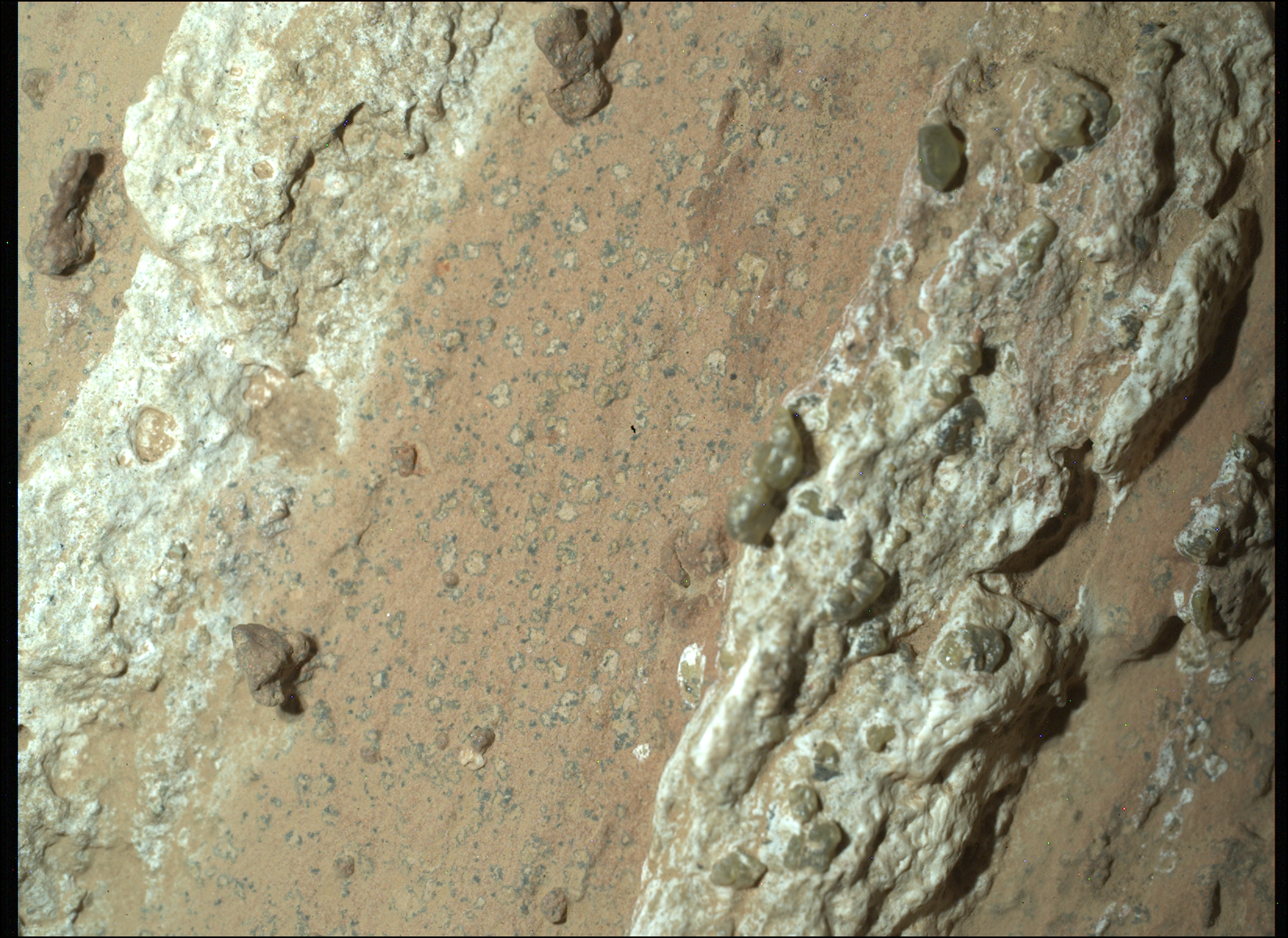
Martian rock with leopard spot patterns photographed by NASA’s Perseverance rover in Jezero Crater.
5 minutes 293

Perseverance detects possible signs of past life on Mars

On September 10, 2025, NASA announced that its Perseverance rover, exploring Jezero Crater, had collected a rock sample containing features consistent with what scientists call a potential biosignature. This is likely the most convincing indication of past life on Mars to date. The elements detected in this rock are generating tremendous excitement within the scientific community.

Mission and site context

The Perseverance mission, launched in 2020, aims to explore ancient environments that may have hosted life and to collect samples for a future return to Earth as part of the Mars Sample Return program. This mission, however, may never materialize due to budget cuts implemented under the Trump administration.

Jezero Crater was chosen specifically for its geological past: it once contained a lake and river delta, known for their ability to preserve possible traces of life.
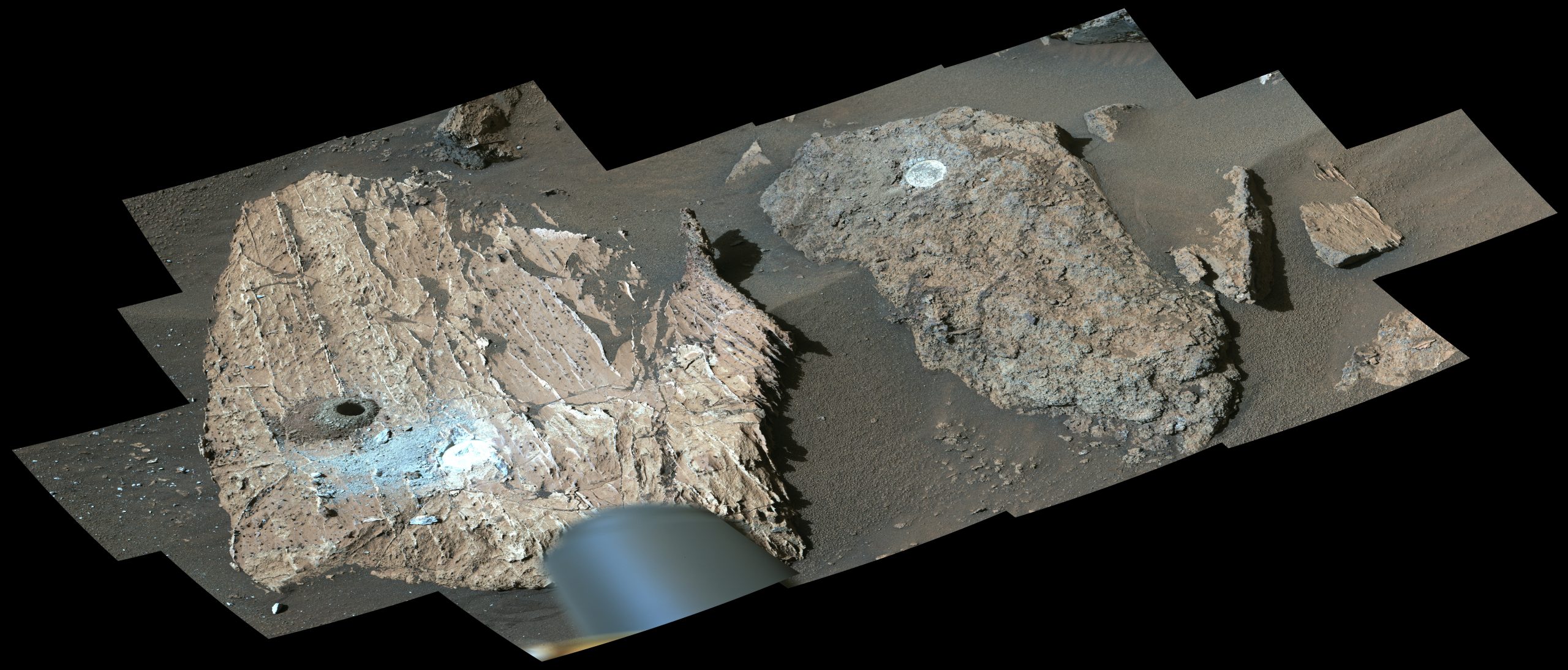
Mastcam-Z mosaic of the Cheyava Falls rock outcrop on Mars, showing drill holes created by Perseverance to collect samples.
Mosaic captured by the Mastcam-Z camera aboard NASA’s Perseverance rover, showing the rock outcrop nicknamed Cheyava Falls in Jezero Crater. The drill holes mark sites where samples were collected for future return to Earth. Credit :
NASA/JPL-Caltech/ASU/MSSS

Analysis results

Detected minerals

Perseverance’s instruments revealed the presence of vivianite (a hydrated iron phosphate) and greigite (an iron sulfide). On Earth, these minerals often form in association with organic matter and microbial processes. On the Martian rock, they appear as colorful patches resembling leopard skin, as well as in millimeter-scale interfaces between different mineral layers.

Chemical composition

The sample also contains organic carbon, sulfur, phosphorus, and oxidized iron. Combined, these elements could have served as an energy source for microbial life forms in the past.

Acting NASA Administrator Sean Duffy summarized the importance of this discovery by stating that it was “the closest result we’ve ever had to discovering life on Mars.”

Formation conditions

Analyses suggest that these minerals formed in low-temperature environments, after the sediments were deposited. Such conditions are particularly favorable for the development of microorganisms.

Mastcam-Z mosaic of the Cheyava Falls rock outcrop on Mars, showing drill holes created by Perseverance to collect samples.
Mosaic captured by the Mastcam-Z camera aboard NASA’s Perseverance rover, showing the rock outcrop nicknamed Cheyava Falls in Jezero Crater. The drill holes mark sites where samples were collected for future return to Earth. Credit : NASA/JPL-Caltech/ASU/MSSS

Why this is considered a potential biosignature

A potential biosignature is a geological or chemical clue that might have a biological origin. However, ambiguity remains: the same minerals can also form through purely geological processes.

Nicky Fox, head of NASA’s Science Mission Directorate, nonetheless reminded that caution is essential: “This is not yet proof of life, but it is a crucial step in our scientific approach.”

Next steps

The next steps will involve conducting more in-depth analyses on site and comparing these observations with known abiotic processes. Most importantly, the success of the Mars Sample Return project will be decisive: only bringing these samples back to Earth will confirm—or rule out—the biological origin of the observed minerals. With this discovery, many hope that the program will be spared from the budget cuts currently under consideration by the government.

Putting things into perspective

This is likely the strongest indication so far in favor of ancient microbial life on Mars. Previous missions had already identified organic compounds, but none had succeeded in isolating minerals as suggestive as these.

If confirmed, these findings would profoundly reshape our understanding of Mars and, more broadly, the possibility of life elsewhere in the Universe. Yet scientific caution remains: no definitive proof exists yet.

Perseverance has uncovered mineralogical and chemical clues of exceptional richness—such as vivianite and greigite—that could represent the imprints of ancient life on Mars. While this discovery does not yet provide proof of the past existence of microorganisms, it marks a major milestone in the search for life’s history on the Red Planet.

Source

Find the article published by NASA on 09/10/2025 here.