
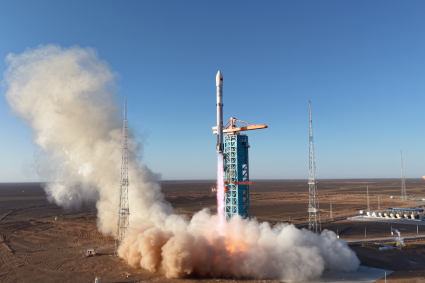





Presentation of the Artemis 2 Mission: First Crewed Flight Around the Moon
More than half a century after Apollo, humanity is preparing to return around the Moon in 2026. With the Artemis program, NASA and its international partners aim to establish a sustainable presence on our natural satellite, as preparation for future missions to Mars. The first crewed step of this new era: Artemis II, which will carry four astronauts on a ten-day journey around the Moon.
Objectives of the Artemis 2 Mission
Artemis II is above all a test flight. Its purpose is to validate the performance of the SLS (Space Launch System) rocket and the Orion capsule, this time with a crew of four astronauts on board.
The mission will:
-
verify life support systems,
-
demonstrate Orion’s ability to maneuver in deep space,
-
test atmospheric reentry under real conditions.
This is not a lunar landing, but an essential step before Artemis III, which aims to land astronauts on the lunar surface.
Flight Path and Profile

The Artemis II flight is expected to last about ten days.
- After liftoff from the Kennedy Space Center in Florida, Orion will complete an Earth orbit before firing its main engine to head toward the Moon.
- The astronauts will fly around our satellite at several thousand kilometers of altitude, without landing.
- Four small satellites provided by South Korea, Germany, Argentina, and Saudi Arabia will be deployed into high orbit to conduct scientific research.
- Finally, the spacecraft will return to Earth and reenter the atmosphere at nearly 40,000 km/h.
Trajectory Video of Artemis II Test Flight (NASA)
Orion will complete two Earth orbits, then perform a figure-eight flyby around the Moon before returning to Earth and splashing down in the Pacific Ocean, off the coast of San Diego.
Following observations from Artemis I, NASA has slightly modified the return trajectory to reduce risks associated with the heat shield.
The Crew: Four Astronauts Making History

The Artemis II crew consists of four astronauts:
-
Reid Wiseman (United States), mission commander.
-
Victor Glover (United States), pilot and the first Black astronaut to fly around the Moon.
-
Christina Koch (United States), mission specialist, the first woman to orbit the Moon.
-
Jeremy Hansen (Canada), mission specialist and the first Canadian to fly on a deep space mission.
Together, they embody the diversity and international collaboration of the program. Their spacecraft has been named Integrity, in tribute to the values of honesty, trust, and cooperation.
Technical Challenges and Delays
Artemis II has faced several delays. Initially planned for 2024, the launch is now scheduled for a window between February and April 2026. If all goes well, liftoff could take place as early as February 5, 2026, though NASA has left itself room until the end of April.
The main challenges encountered are:
-
Orion’s heat shield, which showed signs of erosion during Artemis I,
-
the complexity of integration tests between SLS and Orion,
-
the budgetary and organizational context of the Artemis program.
Despite these obstacles, NASA is proceeding cautiously, with crew safety remaining the top priority.
Animation of the Artemis 2 mission
Looking Ahead
Artemis II will pave the way for Artemis III, which will land astronauts on the lunar surface using SpaceX’s future lunar module, the Starship HLS. In the longer term, NASA plans to build a lunar orbital station, Gateway, and establish a permanent human presence on the Moon. These efforts will serve as a springboard for future crewed expeditions to Mars.
Artemis II is not just a technical test. It is a symbol: for the first time since 1972, humans will once again venture toward the Moon.
Source
Find the latest news about the Artemis 2 mission on NASA’s website here.