




HTV-X1: Japan’s Next-Generation Cargo Ship Successfully Reaches the ISS
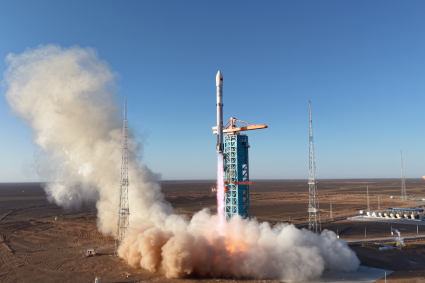
Japan has taken a major step forward in its space program. On October 26, 2025, the Japan Aerospace Exploration Agency (JAXA) successfully launched its brand-new HTV-X1 cargo spacecraft from the Tanegashima Space Center — the first of a completely redesigned generation of resupply vehicles for the International Space Station (ISS).
Three days later, on October 29, HTV-X1 reached the Station and was captured at 4:59 p.m. (Paris time) by the Canadarm2 robotic arm, operated by astronauts Zena Cardman (NASA) and Kimiya Yui (JAXA). The next day, it was securely berthed to the Harmony module by mission controllers in Houston.
A Technical Milestone for Japan and the H3 Rocket
HTV-X1 was launched aboard an H3 rocket, the seventh of this new generation developed by Mitsubishi Heavy Industries as the successor to the H-IIA. After an initial failure in 2023, the following four flights were successful, and this fifth launch further demonstrates the H3’s maturity.
The spacecraft separated nominally from the rocket before beginning its orbital approach to the ISS, successfully completing a series of maneuvering and attitude-control tests without any reported anomalies.
HTV-X: Larger, Smarter, and More Advanced
Replacing the previous HTV “Kounotori” (which flew nine missions between 2009 and 2020), the HTV-X introduces major upgrades:
-
Dimensions: 8 meters tall, 4.4 meters in diameter, with a launch mass of 16 metric tons.
-
Cargo capacity: Up to 4 tons pressurized and 1.75 tons unpressurized, for a total of nearly 6 tons.
-
Faster preparation: Cargo can be loaded just 24 hours before launch, compared to 80 hours for Kounotori.
-
Power: Two steerable solar panels provide 1 kW of power (up from 200 W).
-
Simplified propulsion: A new ring of RCS thrusters replaces 28 individual engines, improving reliability and increasing fuel capacity by 30%.

These improvements not only reduce costs and preparation time but also provide greater operational flexibility — a key advantage for future missions to the Moon and beyond.
A Mission Packed with Science and Innovation
HTV-X1 over the Rocky Mountains, Colorado, USA 🏔️ pic.twitter.com/mgcqeNRaUn
— sen (@sen) October 29, 2025
HTV-X1 carries food, water, oxygen, and research equipment for the Expedition 73 crew. Among its key payloads:
-
A sake fermentation experiment, studying yeast behavior in microgravity.
-
Spare parts for the Japanese Kibo module.
-
Six CubeSats to be deployed later from the Station.
-
The i-SEEP platform (IVA-resuppliable Small Exposed Experiment Platform) for external experiments requiring power and data links.
The mission also includes two technology demonstrators:
-
DELIGHT (Demonstration of ELectronic LIghtweight Green propulsion sysTem), a compact eco-propulsion unit.
-
SDX, a new-generation solar cell for advanced space power systems.
Success in orbit!
Japan’s new cargo ship, HTV-X1, has safely arrived at the @Space_Station, with help from Canada’s robotic arm, Canadarm2. 🦾
More info on Canadarm2’s cosmic catches: https://t.co/ttBfYT2qfi
📷: NASA pic.twitter.com/Sf0aotuHtx
— Canadian Space Agency (@csa_asc) October 29, 2025
Designed to Outlive the ISS
HTV-X1 will remain docked to the ISS for about six months, then spend another three months operating independently in orbit. During this phase, it will test several new instruments, including:
-
The Mt.FUJI laser range finder,
-
A high-altitude satellite deployer,
-
And a lightweight flat antenna for telecommunications.
These experiments will validate technologies needed for the upcoming HTV-XG variant, which will support NASA’s Artemis program and the lunar Gateway station.
Japan Strengthens Its Role in Human Spaceflight
With the dual success of HTV-X1 and the H3 rocket, Japan reaffirms its full command of space logistics — from design to orbital operations. JAXA remains a key partner of the ISS alongside NASA, ESA, Roscosmos, and the Canadian Space Agency, while laying the groundwork for the next frontier: lunar supply missions.
Sources:
Official JAXA press release is (here) and technical specifications available [on JAXA’s website].