



New Glenn NG-2: Blue Origin Achieves Its First Fully Successful Flight and Recovers Its Booster


New Glenn NG-2: Blue Origin Achieves Its First Fully Successful Flight and Recovers Its Booster
The NG-2 mission of Blue Origin’s heavy-lift New Glenn rocket, launched on 13 November 2025, marks a decisive milestone in the company’s spaceflight program. After a successful inaugural flight in January—during which the booster could not be recovered—NG-2 is the first mission to validate all key elements of the launcher’s architecture: a nominal ascent, an accurate orbital insertion, and a controlled recovery of the first stage on its offshore landing platform. It is the first fully successful demonstration of reusability for an American heavy-lift rocket capable of competing with SpaceX.
A Nominal Launch from Cape Canaveral
A perfectly managed ascent profile
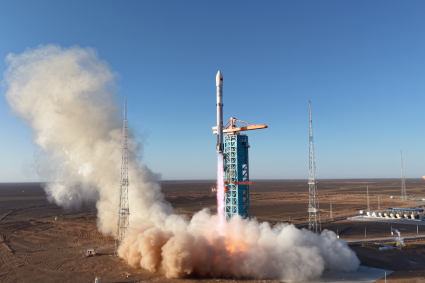
New Glenn lifted off from Launch Complex 36 at Cape Canaveral at 20:55 UTC. Its seven BE-4 methalox engines delivered a stable ascent from liftoff to stage separation, with no anomalies reported. The transonic region, Max-Q, and all guidance corrections remained well within expected margins.
— Jeff Bezos (@JeffBezos) November 13, 2025
Standing 98 meters tall and 7 meters in diameter, New Glenn is now positioned among the world’s largest operational launch vehicles, placing it in direct competition with the strongest heavy-lift rockets currently flying.
Successful Deployment of the Scientific Mission
The rocket’s primary payload, NASA’s ESCAPADE mission to study the Martian magnetosphere, was deployed into the targeted orbit just over thirty minutes after liftoff. Both spacecraft were released according to the planned sequence, confirming the precision and performance of the New Glenn upper stage powered by the vacuum-optimized BE-4U engine.
Leaving Earth… pic.twitter.com/ltSY1ycTtp
— Jeff Bezos (@JeffBezos) November 14, 2025
A secondary technology demonstrator was also carried onboard to test an experimental satellite communications system.
GS-1 Booster Recovery: A Historic Milestone
A controlled return, step by step
Good overview of the landing. We nominally target a few hundred feet away from Jacklyn to avoid a severe impact if engines fail to start or start slowly. We’ll incrementally reduce that conservatism over time. We are all excited and grateful for yesterday. Amazing performance by… pic.twitter.com/DCEMsuSyPm
— Jeff Bezos (@JeffBezos) November 14, 2025
After separation, the GS-1 first stage executed a series of critical maneuvers:
-
a boostback burn to adjust its trajectory,
-
an entry burn to slow down before atmospheric re-entry,
-
a guided aerodynamic descent using its grid fins,
-
and finally a landing burn on the central engine for a controlled touchdown.
— Jeff Bezos (@JeffBezos) November 13, 2025
Each phase was completed nominally.
A precise landing on the Jacklyn barge
— Jeff Bezos (@JeffBezos) November 13, 2025
GS-1 touched down vertically on the Jacklyn landing platform, positioned in the Atlantic Ocean. Post-flight imagery and telemetry confirm a highly accurate landing, validating for the first time the New Glenn program’s ability to recover a first stage intact for future reuse—a major achievement for a heavy-lift launcher of this class.

A Turning Point for Blue Origin and the Space Industry
Reusability architecture validated
NG-2 demonstrates that Blue Origin’s approach—applying rapid reusability principles to a heavy-lift rocket—is viable. Recovering the first stage paves the way for future cost reductions, higher launch cadence, and more efficient use of the company’s industrial infrastructure.
A new credible competitor to SpaceX
Until now, SpaceX was the only organization capable of routinely recovering boosters from orbital-class missions, using the Falcon 9 and Falcon Heavy. With NG-2, Blue Origin becomes the second U.S. company to demonstrate this capability, and New Glenn becomes the third operational reusable launcher in the world.
A market undergoing rapid transformation
New Glenn already holds a significant backlog of missions, including launches for NASA, Amazon’s Kuiper constellation, commercial operators, and institutional spacecraft. By succeeding with NG-2, Blue Origin strengthens its commercial credibility and positions itself as a direct competitor in the heavy-lift launch and advanced orbital missions market.
Next Steps for the Program
Blue Origin has several additional first stages already in production and aims to scale up its launch cadence over the next few years. GS-1, recovered during NG-2, will be thoroughly inspected to prepare for potential reuse. The next mission, NG-3, may become the first to fly with a reused New Glenn booster—an essential milestone toward routine reusability.
With NG-2, Blue Origin has finally proved what it has sought to demonstrate for over a decade: that its heavy-lift launcher, New Glenn, can not only reach orbit with precision but also return its first stage safely to be used again. This mission represents a major technological breakthrough, a strategic win for the company, and a strong signal for the future of competition in the reusable heavy-lift launch sector. NG-2 firmly establishes New Glenn as one of the central players in America’s space landscape for the coming years.
Source
Blue Origin – Official NG-2 Mission Statement (13 November 2025) is [here]