



Oxygen discovered in most distant known galaxy
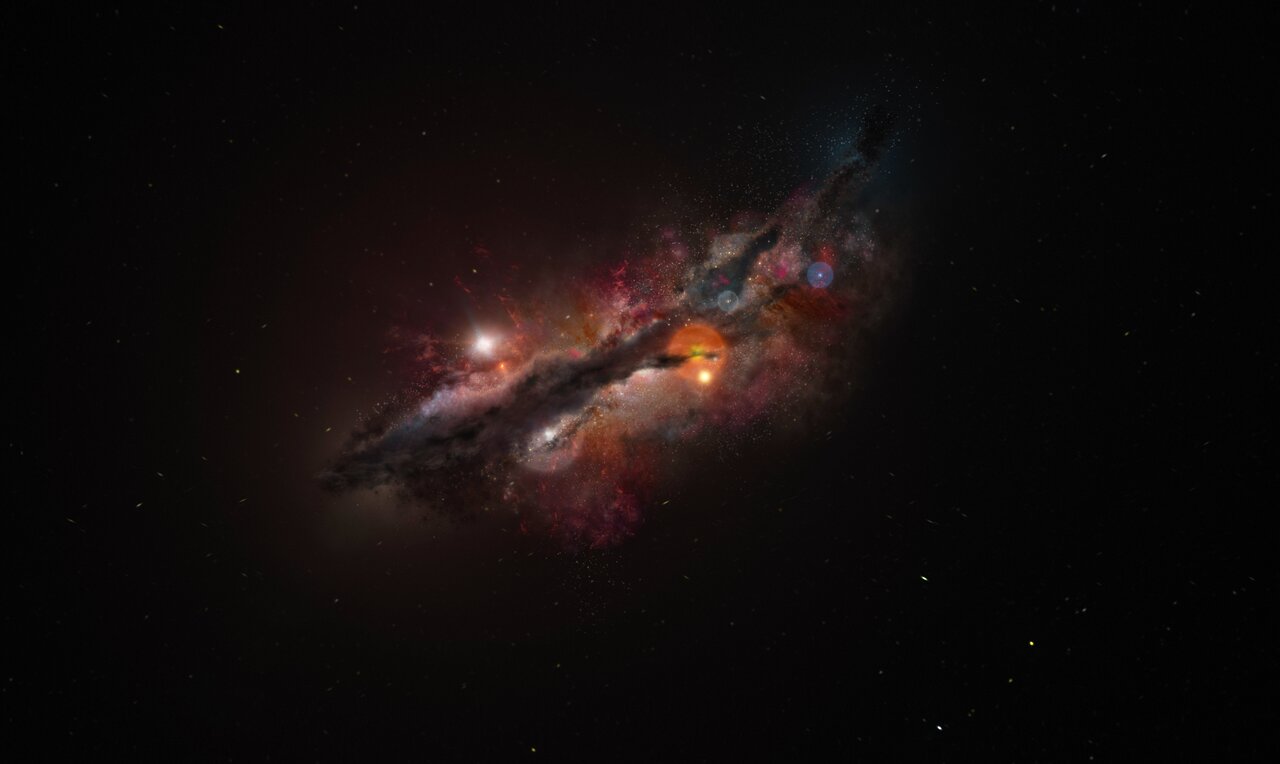
Recent observations with the European Southern Observatory’s (ESO) Very Large Telescope (VLT) have detected the presence of oxygen in the most distant galaxy ever observed. This discovery offers new insights into the formation and evolution of the first galaxies in the Universe.
Press release published by ESO on 20 March 2025
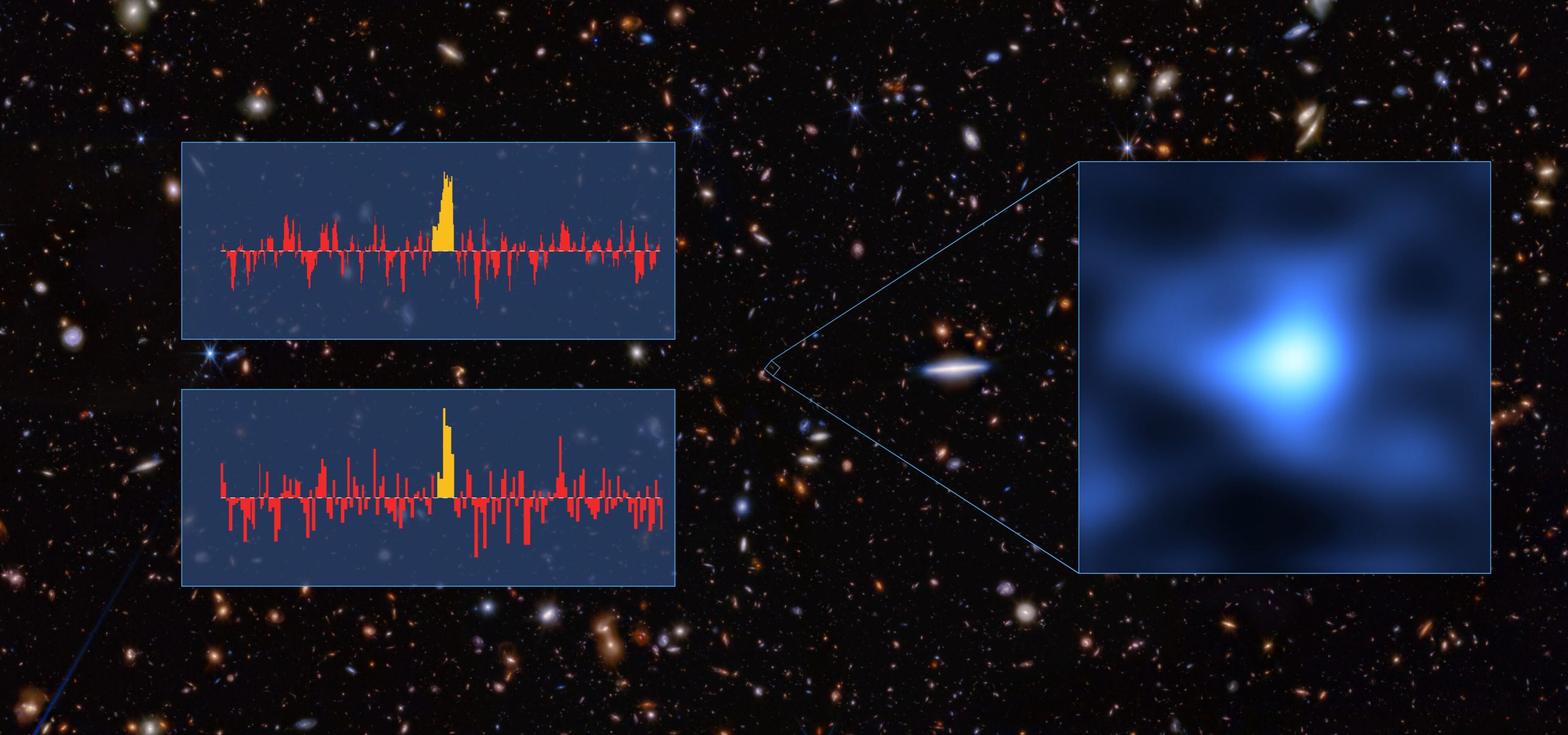
Two different teams of astronomers have detected oxygen in the most distant known galaxy, JADES-GS-z14-0. The discovery, reported in two separate studies, was made possible thanks to the Atacama Large Millimeter/submillimeter Array (ALMA), in which the European Southern Observatory (ESO) is a partner. This record-breaking detection is making astronomers rethink how quickly galaxies formed in the early Universe.
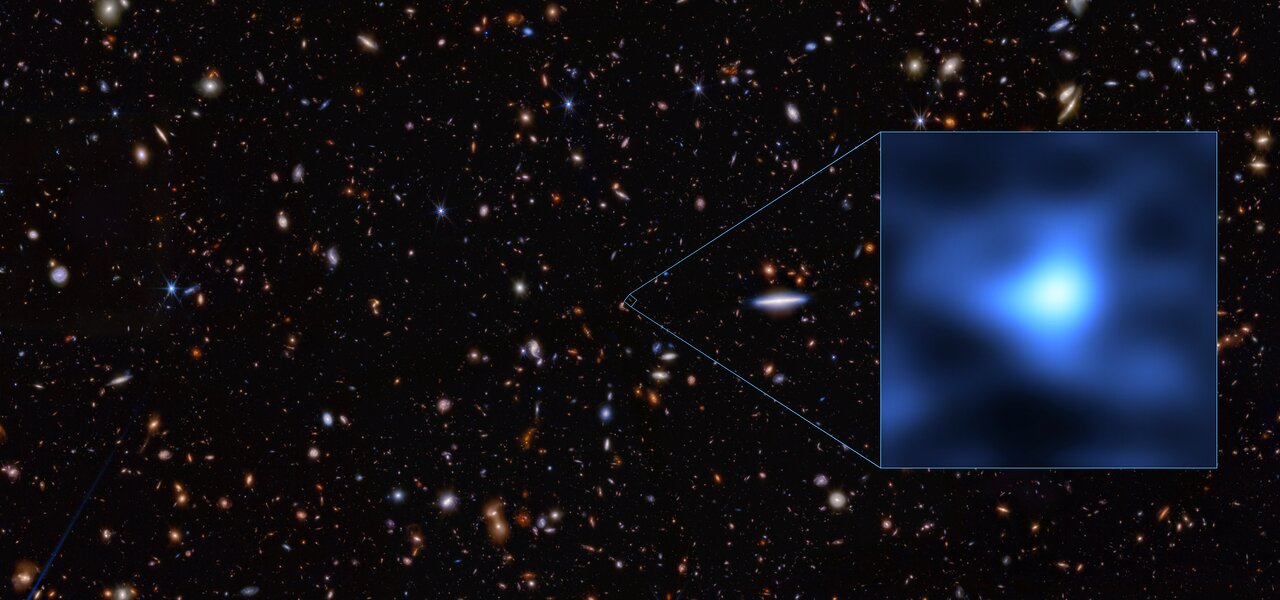
Discovered last year, JADES-GS-z14-0 is the most distant confirmed galaxy ever found: it is so far away, its light took 13.4 billion years to reach us, meaning we see it as it was when the Universe was less than 300 million years old, about 2% of its present age. The new oxygen detection with ALMA, a telescope array in Chile’s Atacama Desert, suggests the galaxy is much more chemically mature than expected. Sander Schouws, a PhD candidate at Leiden Observatory, the Netherlands, and first author of the Dutch-led study, now accepted for publication in The Astrophysical Journal says :
It is like finding an adolescent where you would only expect babies. The results show the galaxy has formed very rapidly and is also maturing rapidly, adding to a growing body of evidence that the formation of galaxies happens much faster than was expected.
Galaxies usually start their lives full of young stars, which are made mostly of light elements like hydrogen and helium. As stars evolve, they create heavier elements like oxygen, which get dispersed through their host galaxy after they die. Researchers had thought that, at 300 million years old, the Universe was still too young to have galaxies ripe with heavy elements. However, the two ALMA studies indicate JADES-GS-z14-0 has about 10 times more heavy elements than expected.
“I was astonished by the unexpected results because they opened a new view on the first phases of galaxy evolution,” says Stefano Carniani, of the Scuola Normale Superiore of Pisa, Italy, and lead author on the paper now accepted for publication in Astronomy & Astrophysics. “The evidence that a galaxy is already mature in the infant Universe raises questions about when and how galaxies formed.”
The oxygen detection has also allowed astronomers to make their distance measurements to JADES-GS-z14-0 much more accurate. “The ALMA detection offers an extraordinarily precise measurement of the galaxy’s distance down to an uncertainty of just 0.005 percent. This level of precision — analogous to being accurate within 5 cm over a distance of 1 km — helps refine our understanding of distant galaxy properties,” adds Eleonora Parlanti, a PhD student at the Scuola Normale Superiore of Pisa and author on the Astronomy & Astrophysics study.
“While the galaxy was originally discovered with the James Webb Space Telescope, it took ALMA to confirm and precisely determine its enormous distance,” says Associate Professor Rychard Bouwens, a member of the team at Leiden Observatory. “This shows the amazing synergy between ALMA and JWST to reveal the formation and evolution of the first galaxies.”
Gergö Popping, an ESO astronomer at the European ALMA Regional Centre who did not take part in the studies, says: « I was really surprised by this clear detection of oxygen in JADES-GS-z14-0. It suggests galaxies can form more rapidly after the Big Bang than had previously been thought. This result showcases the important role ALMA plays in unraveling the conditions under which the first galaxies in our Universe formed. »
Source
The full press release published by ESO is here.