
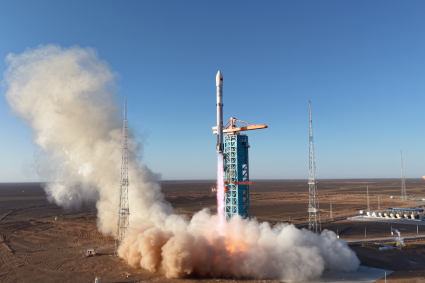





Chang’e 7 and 8: The Chinese Missions Paving the Way for Human Exploration of the Moon
As China aims for a crewed lunar landing before 2030, two major robotic missions are set to prepare the ground: Chang’e 7 and Chang’e 8. These missions will explore the Moon’s South Pole — a region of great scientific and strategic interest for its water ice deposits and near-permanent sunlight. Their goal: to scout the terrain, test new technologies, and lay the first foundations of the future International Lunar Research Station (ILRS).
From Robots to Humans: The Continuity of the Chang’e Program
Since Chang’e 1 in 2007, China has followed a methodical path toward crewed lunar exploration:
-
Observe (Chang’e 1–2): The first two orbiters mapped the lunar surface and analyzed its composition, producing the first 3D maps of the Moon’s topography and minerals.
-
Land (Chang’e 3–4): In 2013, Chang’e 3 achieved China’s first lunar landing and deployed the Yutu (“Jade Rabbit”) rover. In 2019, Chang’e 4 became the first spacecraft in history to land on the Moon’s far side, successfully demonstrating autonomous landing and deploying Yutu-2.
-
Return (Chang’e 5–6): These missions collected and returned lunar samples to Earth — including, in 2024, the first ever from the far side — validating China’s full sample-return chain.
-
Prepare for Humans (Chang’e 7–8): The upcoming missions will focus on exploring the South Pole and testing technologies for in-situ resource utilization — water, oxygen, and energy — key prerequisites for human settlement.
Together, Chang’e 7 and 8 mark the second lunar exploration cycle, the stage of pre-crewed reconnaissance. They will precede the arrival of Chinese astronauts aboard the Mengzhou spacecraft and Lanyue lander by the end of the decade.
Chang’e 7: Surveying the Lunar South Pole
Scheduled for 2026, Chang’e 7 will conduct a comprehensive exploration of the lunar South Pole.
The mission will include four modules:
-
an orbiter for mapping and communications relay,
-
a lander (approx. 8.2 tons at launch),
-
a rover for regolith studies,
-
and a hopping micro-drone, capable of exploring permanently shadowed craters — a world first.
The drone will make short hops using a miniature engine to investigate dark regions that may contain water ice. The payloads will measure surface mineral composition, ground temperature, and light variations across the polar terrain.

According to the CNSA, the Shackleton crater is the leading candidate for the landing site, alongside Amundsen, Haworth, and Schrödinger. International partners are expected to contribute scientific instruments, notably the United Arab Emirates and the European Space Agency (ESA).
Chang’e 8: Technology Demonstrator for the ILRS
Planned for 2028–2029, Chang’e 8 will follow up by testing technologies required for a sustainable lunar presence. The mission aims to demonstrate:
-
additive manufacturing (3D printing) using lunar regolith,
-
oxygen extraction from lunar oxides (ISRU),
-
full automation of a robotic research module, and
-
surface cooperation between multiple robotic systems.
Contrary to speculation, Chang’e 8 will not carry a pressurized crew module but may include a non-habitable structural prototype, designed to test materials and power systems for future habitats.
The CNSA reports that up to 200 kg of international payload capacity will be available. The mission will directly support the International Lunar Research Station (ILRS), developed jointly with Russia and other emerging space nations.
Laying the Foundations of the ILRS
Chang’e 7 and 8 represent the first operational phase of the ILRS, co-developed by the CNSA and Roscosmos. Their purpose: to establish an automated scientific and logistical outpost before human arrival.
Projected Timeline:
-
2026 – 2030: Robotic phase — installation of instruments, antennas, and automated laboratories.
-
2030 – 2035: Crewed phase — arrival of taikonauts via Mengzhou and Lanyue.
-
Post-2035: Permanent phase — operational base and international expansion.
The ILRS is expected to include an orbital platform, a habitat module, a solar power plant, and autonomous logistics vehicles.

Reliable Communications
Both missions will be supported by the Queqiao-2 relay satellite, launched in 2024 into a halo orbit around the Earth-Moon L2 Lagrange point. This satellite ensures continuous communications between Earth and the lunar poles, enabling real-time control and data transmission — even from the permanently shadowed regions that Chang’e 7 will explore.
A Different Path from Artemis
Internationally, Chang’e 7 and 8 serve as China’s counterpart to NASA’s Artemis program. While Artemis relies on Western partnerships and private contractors (SpaceX, Blue Origin), China favors a state-led institutional model, open to countries in Asia, Africa, and Eastern Europe.
If Artemis III returns astronauts to the Moon around 2027–2028, China is pursuing a more gradual approach: robotic reconnaissance, technology validation, and then human missions around 2030. These parallel efforts embody two distinct philosophies of lunar exploration — one commercial and open, the other institutional and centralized.
Chang’e 7 and 8 are pivotal links between China’s robotic achievements and its upcoming human exploration goals. They will help identify available resources, assess environmental risks, and determine the safest and most promising sites for establishing a permanent lunar base.
Sources:
Chang’e 8 (wiki EN); Xinhua – “Chang’e 7 to explore lunar south pole” (2025); China Daily – “Chang’e 8 to test in-situ resource use and 3D printing” (2024); Global Times – “China, Russia unveil ILRS roadmap” (2024); Space.com – “China’s Chang’e 8 mission likely to include in-situ resource utilization, 3D printing bricks.”