




Recap of SpaceX’s Latest Starship Test
The eighth and most recent test of SpaceX’s Starship closely resembled the previous one. While the booster recovery on the launch tower was once again a success, the Starship vehicle itself ended in a spectacular explosion.
Context of the Starship Test
The Starship program has undergone multiple test flights, each providing valuable lessons and challenges to overcome. After a series of notable test flights, including some that resulted in dramatic explosions, SpaceX has steadily improved the design of the launch system, though some issues clearly remain. During the previous test (IFT-7) on January 16, 2025, the separation between the Super Heavy booster and the upper-stage Starship was successful, but the upper stage failed mid-flight before completing its test objectives. This new attempt aimed to validate improvements in reentry procedures and vehicle control during descent. Additionally, adjustments were made to the propulsion system and the thermal shield’s durability to ensure greater stability and resilience. The goal of this test was not only to demonstrate the viability of these technical upgrades but also to bring Starship closer to its first true orbital mission.
Test Flight Overview
Launch Phase
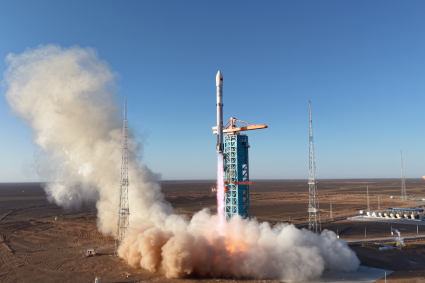
The launch took place from Boca Chica, Texas, where SpaceX conducts the majority of its Starship tests. The Raptor engines of the Super Heavy booster ignited simultaneously, lifting the massive vehicle off the ground against Earth’s gravity. The initial ascent was closely monitored to evaluate the propulsion system’s performance and the aerodynamic stability of the vehicle.
Liftoff of Starship! pic.twitter.com/OL7moLdZ2u
— SpaceX (@SpaceX) March 6, 2025
First Stage Performance
After the separation of the Super Heavy booster and the Starship upper stage, the booster began its descent back toward the launch site. For the third time, SpaceX successfully captured the Super Heavy booster using the mechanical arms of the launch tower.
Mechazilla has caught the Super Heavy booster! pic.twitter.com/JFeJSdnQ5x
— SpaceX (@SpaceX) March 6, 2025
SpaceX is demonstrating increasing mastery in the recovery of the first stage, further refining its booster landing and capture process.
All Three Starship Booster Catches.
We are living in the future, this is WILD. pic.twitter.com/KafTMR0B9R
— Nic Cruz Patane (@niccruzpatane) March 6, 2025
Second Stage Performance
After the successful separation from the Super Heavy booster, the Starship upper stage continued its ascent. However, shortly after some Raptor engines shut down, anomalies began to appear.Several engines failed prematurely, impacting the vehicle’s stability. Without balanced thrust, Starship began spinning uncontrollably at an altitude of 146 km.
The moment Starship went out of control and started spiralling.
Hopefully next launch is fully successful!#Starship8 #SpaceX pic.twitter.com/gDyANW9Lyy
— Lew 𝕏 (@_Lew_X) March 7, 2025
Uncontrolled Spin Leads to In-Flight Explosion
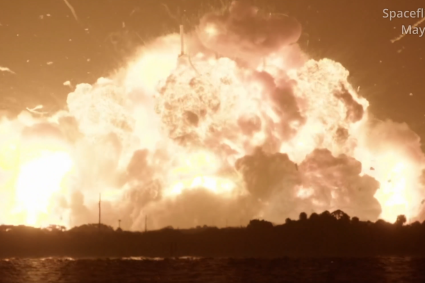
This excessive rotation compromised Starship’s intended trajectory, making any flight correction impossible. As the situation rapidly worsened, SpaceX’s safety systems detected a critical anomaly. Moments later, Starship exploded mid-flight, breaking apart into a fiery cascade of debris, abruptly ending this test attempt.
Learning from Failure for Future Improvements
Despite this setback, SpaceX engineers will analyze the collected data to identify the precise cause of the failure and implement necessary corrections for future tests—hopefully avoiding another mid-air fireworks display.
Just saw Starship 8 blow up in the Bahamas @SpaceX @elonmusk pic.twitter.com/rTMJu23oVx
— Jonathon Norcross (@NorcrossUSA) March 6, 2025
friend on a sailboat in the Caribbean just texted me this
bummer for starship flight 8 pic.twitter.com/V9W1eXJ2X5
— Steve Moraco is Building DATA (@SteveMoraco) March 6, 2025
RIP Starship 8! Great view from the Bahamas. @SpaceX #spacex #starship8 pic.twitter.com/8p2Dcx5gbz
— Stefanie Waldek (@StefanieWaldek) March 6, 2025
Results, Impact, and Analysis
From a strategic standpoint, this test flight has a direct impact on the Starship program’s timeline. A successful flight would have brought SpaceX closer to operational Starship missions, including those planned for NASA’s Artemis program. However, with this failure, Elon Musk’s company will now need to address technical challenges before moving forward.
Each test flight provides valuable lessons, allowing engineers to refine the vehicle’s design and correct identified weaknesses.
Source
The SpaceX page summarizing Starship’s eighth test flight is available here