



Presentation of the Long March 10: The Chinese Launcher Aiming for the Moon
When China unveiled its ambition to land astronauts on the Moon before 2030, one question immediately arose: with which rocket? The answer now fits in two words — Long March 10. Standing about 92 meters tall, this giant represents the new generation of Chinese launch vehicles, designed to carry astronauts and heavy payloads beyond Earth orbit. It forms the cornerstone of China’s strategy to establish a sustainable human presence on the Moon.
A Pillar of China’s Lunar Program
Since the launch of Chang’e 1 in 2007, China has followed a methodical progression: orbit, land, return, and then send humans. The success of Chang’e 6 in 2024 — the first sample return mission from the Moon’s far side — marked the completion of a robotic exploration cycle. The next step, sending humans, requires a rocket capable of lifting heavy payloads toward the Moon: the Long March 10, officially designated CZ-10.
Developed by the China Aerospace Science and Technology Corporation (CASC), the Long March 10 is not derived from previous models; it is an entirely new design, purpose-built for crewed missions.
A Colossus Built to Reach the Moon
In its standard configuration, the Long March 10 stands approximately 92 meters high. Its structure includes a core stage and two side boosters, each five meters in diameter and powered by seven YF-100K engines — 21 engines firing simultaneously at liftoff. The rocket’s total thrust reaches 2,600 tons, nearly double that of an Ariane 5, showcasing China’s growing technical strength.

The YF-100K engine, developed by CASC, powers the lower stages of the rocket and is one of the major technological assets of the program. The second stage is driven by two YF-100M engines, while the third stage uses three cryogenic YF-75E engines optimized for vacuum operations. This combination delivers impressive performance — about 70 tons to low Earth orbit (LEO) and 27 tons to trans-lunar injection (TLI).
A derivative version, the Long March 10A, will be partially reusable. More compact, it will allow recovery of its first stage after flight — a first for China. This version will serve Earth-orbit missions, while the full, non-reusable version will be reserved for crewed lunar launches.
A Colossal Technological Challenge
Launching a rocket with 21 engines requires extreme precision. The slightest imbalance in thrust could jeopardize flight stability. Engineers at the China National Space Administration (CNSA) are carefully testing engine synchronization, cryogenic resistance, and emergency abort systems to ensure maximum reliability.
Promising Tests in Wenchang
The Wenchang Space Launch Center, on Hainan Island, has become the beating heart of the program. In 2025, several successful static-fire tests of the first stage were completed, during which the seven YF-100K engines fired simultaneously for 320 seconds, validating thrust stability and structural integrity.
Next steps include stage separation trials and sequential ignition tests in simulated flight conditions. If the schedule remains on track, the first orbital flight could take place in 2027, paving the way for crewed certification before the end of the decade.
The Core of China’s Lunar Architecture
For a crewed lunar landing, China has chosen a dual-launch architecture:
-
The first Long March 10 will place the Mengzhou crew capsule and astronauts in lunar orbit.
-
The second rocket will carry the Lanyue lunar lander and its propulsion module.
-
The two spacecraft will rendezvous in lunar orbit.
-
The taikonauts will transfer to Lanyue, descend to the surface, then rejoin Mengzhou for the return trip to Earth.
This mission profile is partly inspired by Apollo, though simplified in some phases. Crucially, it relies on a 100% domestic supply chain: the launcher, spacecraft, and lander are all designed and built in China.
The American Rival: NASA’s SLS
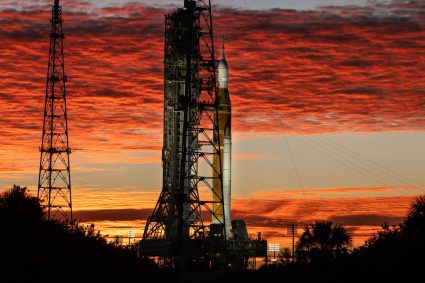
Comparison with NASA’s Space Launch System (SLS) — developed for the Artemis program — is inevitable. While the SLS can lift about 95 tons to LEO, China has opted for a different philosophy: two coordinated launches instead of a single super-heavy one.
The Long March 10 doesn’t aim for sheer power but for reliability and cadence. Its development relies on an integrated production model — engines, tanks, avionics, and controls are all built within the same industrial ecosystem. This minimizes subcontracting and could result in a higher launch rate than the SLS, though achieving crewed flight certification remains a significant challenge.
The Key to China’s Lunar Ambition
The Long March 10 is more than a rocket — it’s a symbol of China’s transformation into a full-fledged space power. Like Saturn V for the United States in the 1960s, it embodies a fusion of scientific ambition and national pride.
If Wenchang’s tests continue successfully, China could have all the necessary components for a crewed lunar mission by 2028–2029. Every engine ignition, every successful test, brings Beijing one step closer to its goal: seeing the Chinese flag on the lunar surface before the end of the decade.
Sources
-
China Global Television Network (CGTN) – “Long March 10 successfully completes second static fire test”, September 13, 2025.
-
Global Times – “China’s Long March 10 completes 320-second ground test”, August 2025.
-
Xinhua English News – “Long March 10 carrier rocket prepared for manned lunar missions”, August 15, 2025.
-
Wikipedia (EN) – Long March 10 rocket.
-
China In Space – Analysis – “Long March 10 roars to life in Wenchang”, 2025.
2 commentaires sur « Presentation of the Long March 10: The Chinese Launcher Aiming for the Moon »
Les commentaires sont fermés.