




Mengzhou: The New Chinese Spacecraft That Will Carry Taikonauts to the Moon
China is entering a new era in human spaceflight. Alongside the development of its next-generation heavy-lift rocket, the Long March 10, Beijing is designing Mengzhou, the crewed spacecraft that will take its astronauts to the Moon before the end of the decade.
A Capsule for a New Era
Since the early 2000s, China’s crewed space program has relied on the Shenzhou spacecraft series to ferry taikonauts to the Tiangong space stations. These spacecraft, inspired by Russia’s Soyuz design, were limited to low Earth orbit (LEO) missions.
With Mengzhou (梦舟, “Dream Vessel”), China takes a decisive step forward: developing a vehicle capable of carrying crews beyond Earth orbit, toward the Moon. Developed by the China Aerospace Science and Technology Corporation (CASC) under the supervision of the China National Space Administration (CNSA), Mengzhou is set to become the cornerstone of China’s manned lunar exploration program.
Designed with modularity in mind, Mengzhou can support both low Earth orbit missions and long-duration lunar missions, embodying China’s ambition to possess a fully independent human spaceflight system: launcher, spacecraft, and lunar lander.
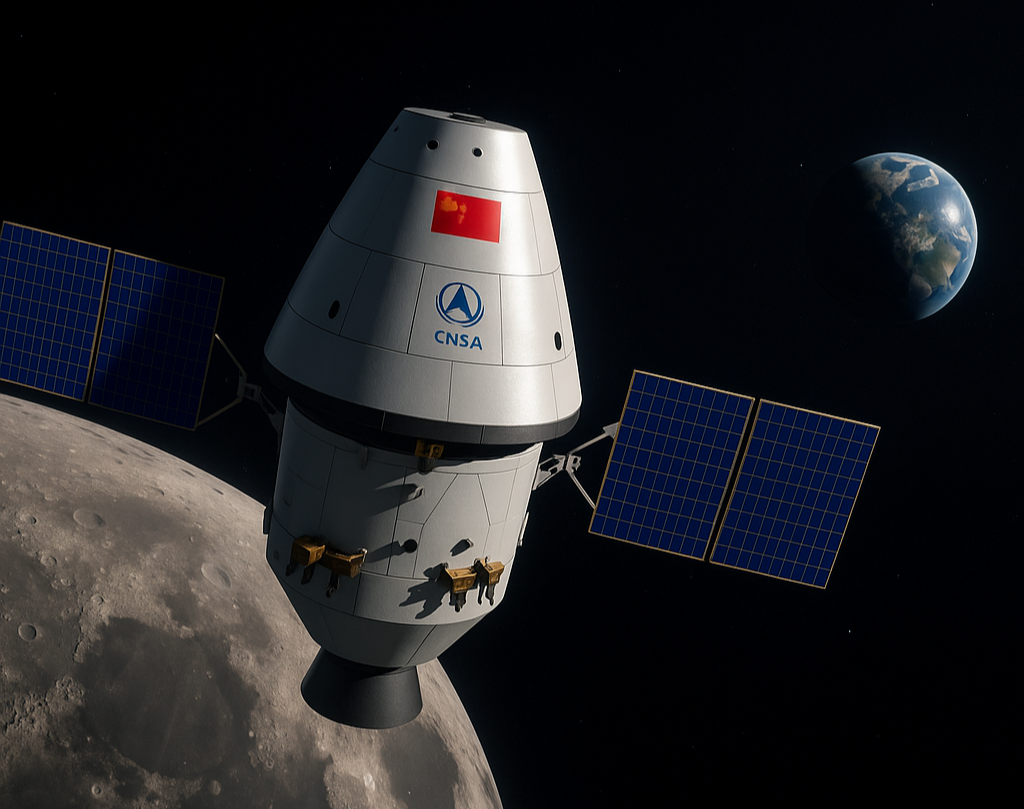
The Mengzhou spacecraft consists of a reentry module (top) and a service module (bottom). This new-generation spacecraft, developed by CASC for the CNSA, is intended to carry taikonauts on future lunar missions.

An Ambitious Design
Mengzhou comprises two main sections:
-
Reentry module (pressurized) – approximately 3.3 meters in diameter, housing the crew and providing life support and Earth return capability.
-
Service module (unpressurized) – up to 4.5 meters in diameter, containing propulsion systems, fuel tanks, solar arrays, and thermal control systems.
The lunar version of Mengzhou measures roughly 8.8 meters in total length, compared to 7.2 meters for the LEO variant. Its launch mass is estimated at 22 metric tons, and it can carry six to seven astronauts depending on mission configuration. The heat shield is designed to withstand reentry speeds exceeding 9 km/s.
First Flight: Proof by Flight
On May 5, 2020, Mengzhou performed its first test flight aboard a Long March 5B rocket launched from Wenchang. A non-crewed qualification version was placed in orbit and returned to Earth after about 67–68 hours (2 days and 19 hours), landing on May 8, 2020, at 05:49 UTC in the Dongfeng Desert, Inner Mongolia.
The goal was to test the heat shield, reentry sequence, parachute deployment, and landing airbags. All systems functioned nominally, and the capsule was recovered in good condition at the Dongfeng site.
Pad Abort Test — A Major Step Forward in 2025
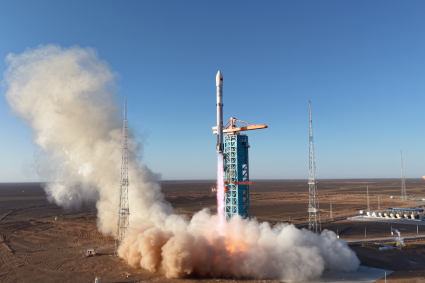
A significant milestone was reached on June 17, 2025, when China conducted a zero-altitude pad abort test of the Mengzhou spacecraft at the Jiuquan Satellite Launch Center.
Test sequence:
-
At 12:30 PM Beijing time, the escape system was activated: solid-fueled abort motors ignited, propelling the capsule and its escape tower upward.
-
Within about 20 seconds, the system reached the designated altitude, the capsule separated cleanly, parachutes deployed, and at 12:32 PM, Mengzhou landed softly within the planned recovery zone, cushioned by airbags.
This test successfully validated the integrated escape and survival subsystem, confirming the timing, trajectory control, and overall reliability of the abort mechanism.
It was the first zero-altitude abort test conducted by China since Shenzhou’s test in 1998, marking a major advance in crew safety for deep-space missions.
Versatile and Lunar-Oriented
Mengzhou will be available in two main configurations:
-
Low Earth Orbit Version (“short version”) – for crew and cargo transport missions.
-
Lunar Version (“long version”) – featuring a larger service module with extended power and life-support capacity.
In the lunar scenario, Mengzhou will be launched aboard Long March 10, perform orbital rendezvous around the Moon with the Lanyue lunar lander, receive the crew after their lunar surface mission, and return them safely to Earth.
A Credible Rival to NASA’s Orion
Comparing Mengzhou with NASA’s Orion capsule highlights their similarities and differences:
| Feature | Orion (NASA) | Mengzhou (China) |
|---|---|---|
| Length | ~8.9 m | ~8.8 m |
| Launch Mass | ~26 t | ~22 t |
| Architecture | Capsule + Service Module | Capsule + Service Module |
| Launcher | SLS | Long March 10 |
| Origin | U.S. + ESA collaboration | Fully domestic Chinese design |
Both share a two-module design and similar mission profiles. However, Orion relies on international cooperation and the SLS, whereas Mengzhou is part of a fully Chinese-built system, giving it strategic independence and cost control advantages.
While Orion has already completed a circumlunar mission (Artemis I, 2022), Mengzhou remains in the testing phase. The first crewed qualification flights are expected around 2028, according to current projections.
Outlook and Timeline
The CNSA aims to have the crewed lunar version of Mengzhou operational by 2030. The roadmap includes:
-
A crewed orbital qualification flight in the late 2020s
-
A circumlunar mission (without landing)
-
Followed by a full lunar landing mission, in cooperation with the Lanyue lander, before 2030
The successful 2025 abort test has boosted both the safety and credibility of the program. Mengzhou could also play a vital role in missions to the International Lunar Research Station (ILRS), a joint China–Russia project to establish a permanent lunar base.
With Mengzhou, China is equipping itself with a next-generation crewed spacecraft capable of exploring beyond Earth orbit. The capsule embodies the maturity and coherence of China’s expanding space program: from launcher (Long March 10) to lunar lander (Lanyue), Mengzhou connects every key element. If upcoming orbital and integration tests proceed as planned, Chinese taikonauts could perform a circumlunar flight before the end of the decade — paving the way for a historic lunar landing. True to its name, the “Dream Vessel” may soon turn China’s lunar dream into reality.
Sources used for this article:
-
Xinhua / English gov.cn — “China successfully conducted escape flight test on Mengzhou at zero altitude,” June 17, 2025
-
Global Times / CGTN — Coverage of the zero-altitude abort test
-
China Daily — Technical review of Mengzhou and test outcomes
-
Wikipedia (EN) — Technical data on Mengzhou, 2025 pad abort, architecture
-
Universe Today — Context and analysis of the abort test